
Literature Review
The evil pirate Lord Bloth sails to the ruins in pusuit of a castaway prisoner, who reveals with his dying breath to Ren that he is the former King Primus of Octopon, and Ren’s father!
Prince Ren takes up his father’s broken sword and magic compass, to complete his quest: to seek the magical Thirteen Treasures of Rule. These treasures have the power to restore the ruined lands of Mer and drive back the Dark Water.
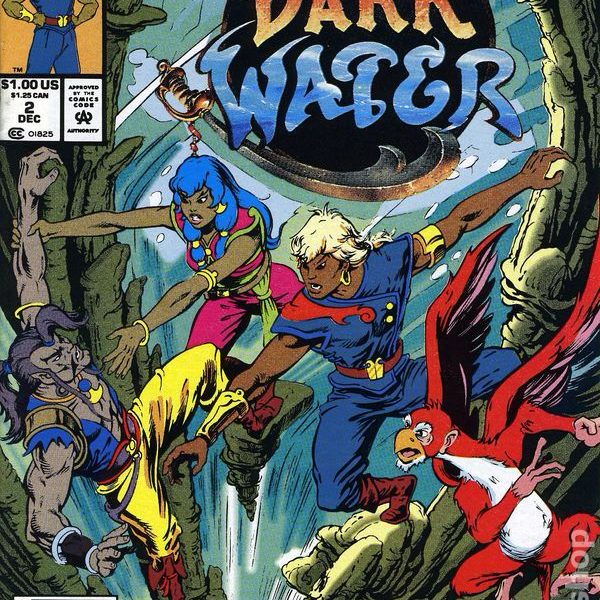
Ren brings together, to use the show’s phrase, “an unlikely but loyal crew of misfits” including the cynical pirate Ioz, the beautiful magician-warrior Tula and Lord Bloth’s former slave, the monkey-bird Niddler on the good (stolen) ship Wraith. Together they seek for the Treasures, fighting off sorcerers, sea monsters, barbarians, cultists and the unrelenting Bloth, who covets the Treasures and their power over Dark Water for himself.
It also stands out in the quality of its visuals. Keep in mind that Hanna Barbera was known at the time for limited-style cartoons like Yogi Bear, the Flintstones, Scooby Doo and the Jetsons. It made for efficient and economical production, but the consequence was that their characters never moved more than the minimum necessary. This resulted in characters whose heads seem only informally attached to them, and who run like Riverdance, with upper bodies stock still above legs cycling like windmills.
The Pirates of Dark Water is a criminally underrated gem of early ’90s animation—a bold, genre-blending epic from Hanna-Barbera that aired from 1991 to 1993. Originally launched as a five-part miniseries titled Dark Water, it quickly captivated audiences with its lush animation and high-stakes storytelling. After some visual refinements, those initial episodes were re-aired later that year as the opening arc of the full series.
Set on the alien world of Mer, the series unfolds across a sprawling archipelago of fantastical islands, each teeming with unique cultures, creatures, and arcane secrets. The lore is deep and immersive: the Thirteen Treasures of Rule, the cursed kingdom of Octopon, and the sentient, malevolent substance known as Dark Water all contribute to a mythos that feels ancient and alive. Every detail—from the coral-encrusted ruins to the biomechanical ships—reinforces the sense of a world both wondrous and perilous.
At the heart of the tale is Prince Ren, heir to the fallen kingdom of Octopon, who sets sail aboard the Wraith to recover the Treasures and save his world from the encroaching Dark Water. He’s joined by a ragtag crew of allies: Tula, a fierce ecomancer with secrets of her own; Ioz, a gruff pirate with a heart of gold (and a lust for treasure); and Niddler, a monkey-bird with a knack for comic relief and unexpected heroics. Their nemesis is the formidable Bloth, a monstrous pirate lord commanding the dread ship Maelstrom, who seeks the Treasures for his own dark ends.
Significance of the Study
The Pirates of Dark Water takes place on the planet Mer, a planet suffering the effects of “Dark Water” (a cancerous, black fluid that destroys all it touches), and follows the altruistic mission of Ren, an unassuming and unknowing prince, as he quests to find the Thirteen Treasures of Rule and restore Mer to health. Along for the ride are a band of misfits: Tula, an ecomancer, Ioz, a greedy pirate, and Niddler, a monkey-bird; this unseemly crew bad together to assist Ren in his journey restore the city of Octopon and to save Mer. In their way is the devilish pirate Bloth, a feared man throughout the oceans of Mer and a seeker of the Treasures of Rule. I would be remiss if I didn’t also include “Dark Water” as the most consistent villain of the series. An occurrence created by a being known as the Dark Dweller, the penultimate evil force in the series, and the cause of the Treasure of Rule getting scattered.
Dark Water is an intelligent fantasy adventure. Taking aspects of serialized construction, but inflecting that with episodic notes gives different pacing to the series. While each episode builds on the overall journey to collect the Thirteen Treasures of Rule, we can watch them as singular episodes without the 100% need for prior episode knowledge. In this instance that works, as it allows Dark Water to better explore the limited characters we meet. Typically I find myself more engaged with a serialized construction, but, in this case, Dark Water pulls off the episodic model well due to its ability to focus more on the radically different characters. In doing so, viewers get a better chance to explore individual characters with no unnecessary shoehorned backstory episodes.
The Pirates of Dark Water only lasted 21 episodes before its cancellation, so Ren never got the chance to collect all Thirteen Treasures of Rule. And, normally, that would be a disappointment; but, in this case, I am not a particular fan of Dark Water. I feel a greater sense of disappointment when I say that out loud, The Pirates of Dark Water is a show that straddles two different cartoon eras and could not successfully pull that amalgam off. As the series was produced through Hanna-Barbera it feels more like an 80s misstep than forward-thinking 90s adventure romp. I’m glad I took a second look through the series, but I just could not get behind the loving hype this show has garnered.