Background of Study
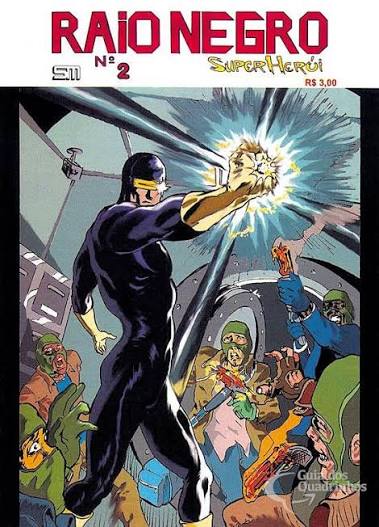
The creator of the Brazilian character Black Lightning. GEDEONE MALAGOLA was born in São Paulo, 1924. The guy scripted, drew, argued and edited comics, I wouldn’t find it strange if he had stapled the comics and still went out to sell Fanzine on the street, he did everything in national comics, and in others not so national.
The great master of national comics Gedeone Malagola departed from this troubled planet on September 15, 2008, leaving a legacy of hard work and creativity. The master had been absent from the drawing board for many years due to his delicate state of health and in recent times several comic book professionals were helping him to regain his space in the media. Among them the comic artist and editor Daniel Vardi, who put on the air a website in honor of Black Lightning, Gedeone’s main character, where the public can learn more about the artist’s life and his work. To know the site click here. Another professional who helped Gedeone a lot in the last months of his life was Manoel de Souza, editor of the magazine World of Super-Heroes. Manoel, in a very noble and respectful gesture, invited Gedeone to be part of the magazine’s staff and gave him a fixed section, where the master wrote about Golden Age superheroes (40s and 50s). In this month’s issue, on newsstands, Gedeone wrote about The Ray, a character that appeared in the Golden Age and that in the 90s was bought by DC comics and reformulated.
Finally, the editor and writer José Salles, who in recent years has been republishing all of Gedeone’s work through his publisher Jupiter II (a clear tribute to Gedeone’s publisher in the 50s). Many new readers got to know Gedeone’s characters through Salles’ editions. For the new generations, who may not have been very familiar with Gedeone’s work, here is a brief summary of the prolific trajectory of this one who was and always will be one of the fundamental names of Brazilian comics:
Gedeone studied Architecture, but ended up graduating in Law. His interest in drawing was stimulated since childhood thanks to the conviviality and influence of his father, who was a painter. It would be, however, as a screenwriter that he would achieve greater prominence in his career that began in the 40s. An avid reader, Gedeone Malagola had the habit of researching the topics he wrote about in order to familiarize himself with the subjects and his scripts used to be quite detailed. His first collaborations were for the newspaper A Marmita, where he wrote and drew, and then for the newspaper O Governador. He worked at Editora La Selva, later going to Vida Juvenil, where under the direction of Mário Hora Jr., he produced the Milton Ribeiro series, of cangaceiro characters. He founded Editora Júpiter, which had the work of several Brazilian designers. At Editora Outubro, with Miguel Penteado, he produced horror stories, but also wrote and drew children’s stories, his favorites. Gedeone also worked with superheroes, creating within the genre the character Black Lightning, his main character and one of the most beloved Brazilian heroes, in addition to Hydroman and Moonman. A great curiosity is that Gedeone loved to draw himself as the villain Captain Op-Art (short for Optical Art, a subgenre of modern and contemporary art), an illusionist and psychedelic criminal, and Black Bolt’s main enemy. Gedeone was also one of the writers of Captain 7, the most successful Brazilian superhero of all time.
Literature Review
Lieutenant Roberto Salles is a FAB pilot who, when sent into space on a secret mission in orbital flight, ends up finding a flying saucer. Inside the ship is the alien Lid, from the planet Saturn.
By risking his life to save the alien who was seriously injured, Roberto receives a reward, the black light ring made with Saturn’s magnetic energy, and which confers super powers on its owner.
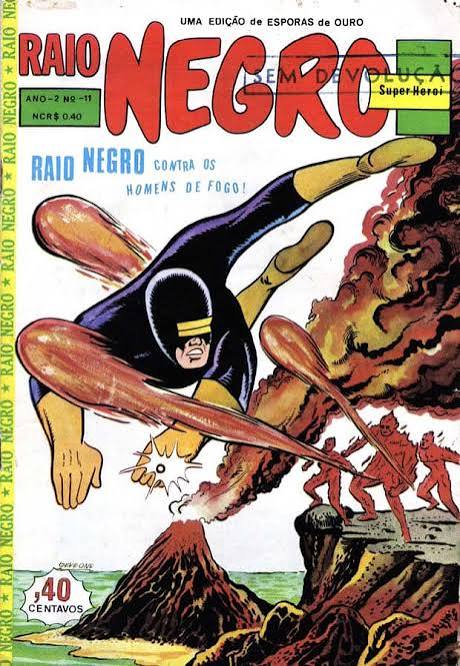
There is no denying that the emergence of BLACK LIGHTNING in 1964 was a kind of milestone in the history of Brazilian superheroes. Created by Gedeone Malagola, the character is considered one of the first Brazilian superheroes and its author scripted and drew Black Lightning in 24 adventures, also being published in almanacs and in the magazine “Edições GEP” (starring the “X-Men”).
The story of its creation is very curious, because when the Moon Man was refused by GEP, its editors asked Gedeone to take a look at the “Green Lantern” pilot that was making a splash in the US at the time (that is, the fact that Roberto is a pilot and his origin has to do with an alien is also no coincidence), and in a hurry, “Black Lightning” appeared, in the 60s it was common for publishers to ask artists and writers to create generic songs of the gringos. The look, although similar to “Cyclops from the X-Men” may have been just a coincidence, since Gedeone said he based his visor on a character from “Terry and the Pirates”, not to mention that before “Cyclops”, there were other characters with a visor, including Nilats, a Space Patrol villain created in 1953 by Gedeone himself.
The point is that Black Ray greatly encouraged the creation of other characters and today Brazil has a great team of national heroes.
For me, Black Lightning represents the beginning of the superhero universe in Brazil, just as Superman must have greatly encouraged the creation of many other heroes with super powers, Black Lightning in Brazil also did the same, not for his originality (since we saw that he is not that original), but for what he represented. It was now possible to create our own superheroes