
Literature Review
Sunny lives in Nigeria, but she was born in New York City. She looks West African, but is so sensitive to the sun (due to her albinism) that she can’t play soccer during the day. She doesn’t seem to fit in anywhere.
Then she learns why.
Her classmate Orlu and his friend Chichi reveal that they have magical abilities- and so does she. Sunny is a “free agents,” overflowing with latent power. And she has a lot of catching up to do.
Orlu and Chichi have been working with their teacher for years. Sunny needs a crash course in magical history, spells, juju, shape-shifting and dimensional travel. Her new world is a secret from her family, but it’s well worth all of the silence, exhaustion and sneaking around.
Still, there is a dark side. After she’s found her footing, Sunny, Orlu, Chichi, and their American friend Sasha are asked by the magical authorities to help track down a criminal. Not just a run-of-the-mill bad guy. A real-life hardcore serial killer-with abilities far stronger than theirs.
A year ago, Sunny Nwazue, an American-born girl Nigerian girl,
was inducted into the secret Leopard Society. As she began to develop
her magical powers, Sunny learned that she had been chosen to lead a
dangerous mission to avert an apocalypse, brought about by the
terrifying masquerade, Ekwensu. Now, stronger, feistier, and a bit
older, Sunny is studying with her mentor Sugar Cream and struggling to
unlock the secrets in her strange Nsibidi book.
Eventually, Sunny knows she must confront her destiny. With the support of herLeopard Society friends, Orlu, Chichi, and Sasha, and of her spirit
face, Anyanwu, she will travel through worlds both visible and invisible
to the mysteries town of Osisi, where she will fight a climactic battle
to save humanity.
From the moment Sunny Nwazue discovered she had mystical energy flowing in her blood, she sought to understand and control her powers. Throughout her adventures in Akata Witch and Akata Warrior, she had to navigate the balance between nearly everything in her life—America and Nigeria, the “normal” world and the one infused with juju, human and spirit, good daughter and powerful Leopard Person.
Now, those hard lessons and abilities are put to the test in a quest so dangerous and fantastical, it would be madness to go…but may destroy the world if she does not. With the help of her friends, Sunny embarks on a mission to find a precious object hidden deep in an otherworldly realm. Defeating the guardians of the prize will take more from Sunny than she has to give, and triumph will mean she will be forever changed.
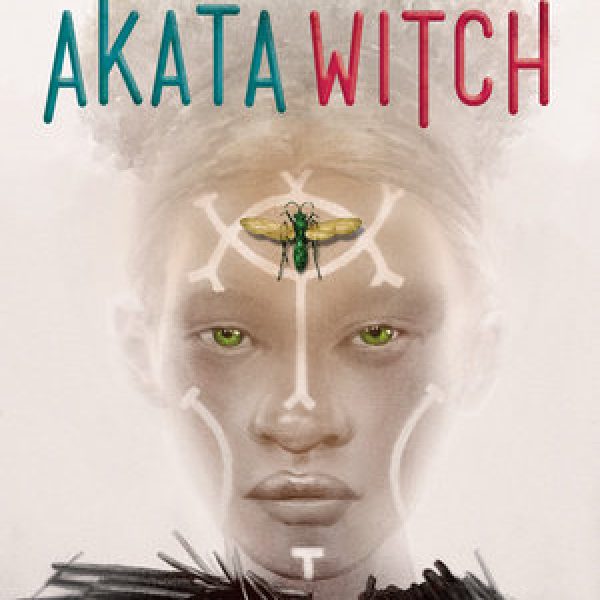
Akata Witch follows the story of Sunny, a twelve-year-old African-American albino whose family recently moved back to their native Nigeria. Because of her odd looks and African American heritage, Sunny is ostracized by her peers to an extent typical of any book featuring an albino character. Nonetheless, with the help of some friends, Sunny discovers that she is capable of much more than she realized. She is a “leopard person,” a secret race of peoples in Nigerian folklore who walk between the human and spirit worlds and are capable of practicing “juju.” Soon she is whisked into a world of magic, masquerade, and monsters as she slowly assumes her role as a leopard person. Here Okorafor uses her expertise with Nigerian folklore to paint a truly marvelous world outside anything any Western reader could imagine. Each scene brims with foreign words, ideas, and languages in a way that draws the reader into the page.
As I mentioned, albinism is a characteristic most commonly applied to either the weakest or most malevolent characters. Their shocking appearance either provides an air of sickly paleness accompanied by either a physical or emotional weakness, or a frighteningly brutal ghost-like appearance which elicits revulsion from the reader and character alike. Akata Witch is one of the few novels I’ve read that breaks this particular mold. While Sunny’s albinism draws the ridicule of her classmates, Okorafor ensures that Sunny’s character is not tarnished by her physical disabilities or the stigma of her peers. In fact, Sunny’s albinism affects her character in a positive way, as dealing with the physical and social aspects of her albinism help build her confidence. She refuses to allow taunts and abuse to compromise her integrity and is never afraid to defend herself from those who see her as inferior.
Unlike many authors, Okorafor pulled no punches in regards to society’s treatment of those with albinism. As a person of color growing up with albinism, Sunny’s character particularly resonated with me. Her interactions with her classmates and countrymen strongly resembled my own. The odd looks and comments that Sunny deals with from her Nigerian counterparts are familiar to any “albino of color” as we see the confusion in the faces around us—as if we’re pieces in a puzzle that don’t fit correctly. Between the devices we use to protect ourselves from the sun, the blond or white hair, and the pale skin, we’re seen as misfits even among our own societies. Nevertheless, Okorafor does not allow Sunny to succumb to this atmosphere. Unlike most characters with albinism who are meek, easily manipulated characters, Sunny is an athletic, adventurous, and confident preteen who is not held back by her albinism and is quick to challenge those who question her looks or sun-shield umbrella. In fact, in the Leopard society her condition is seen as an indication of her power and abilities rather than a reason to ostracize her.
However, Sunny’s ready acceptance into Leopard society also plays into the “magical albino” myth that permeates fantasy movies and novels. While Okorafor attempts to distance Sunny’s albinism from the novel’s mysticism, in Leopard society a Leopard person’s abilities are very much influenced by their most striking physical features and/or maladies; the more striking or severe the disability, the more powerful the associated magic. Thus, while in principle Sunny’s albinism is not meant to contribute to the “magical albino” myth, Okorafor’s use of Leopard society ideology and mythology invokes an element of the aforementioned trope which mars what otherwise is an unprecedentedly mundane depiction of albinism.
While Sunny’s character is strongly affected by her albinism, Okorafor ignores or marginalizes some aspects of the condition. Because of our lack of melanin, people with albinism tend to have varying degrees of low vision. But Sunny didn’t suffer from any type of visual impairment; she didn’t even suffer from photophobia, the most common visual impairment associated with albinism. Okorafor’s mysterious “cure” for Sunny’s susceptibility to sunburn was an even more blatant affront to the integrity of her albinism. Soon after Sunny’s magical awakening, she discovers that she is no longer affected by sunlight—that she no longer has to worry about using an umbrella or long clothes to protect herself in the sun. As photophobia (in my opinion) is the most cumbersome physical symptom associated with albinism, Okorafor’s cure does the novel a disservice as she frees Sunny from a burden that every other albino must consciously shoulder or risk the consequences.
From the perspective of its portrayal of albinism I must confess to being underwhelmed by Akata Witch. While I loved Sunny’s character, Okorafor seemed to pick and choose from the physical and social aspects of albinism to craft a character that suited her needs rather than creating a truly realistic character with albinism, and—perhaps unintentionally—strayed back into the “magical albino” trope that mars so many novels with characters with albinism. However, from a literary standpoint Akata Witch is a great novel that features the first strong, sympathetic lead with albinism I’ve seen in quite a few years. With a wonderful setting that provides a breath of fresh air to an otherwise tired premise, accurate, life-like characters, and a great message,
12-year-old, American born Sunny Nwazue feels out of place in her ancestral home of Nigeria. As an Albino, she is often mocked for her pale skin and yellow hair and struggles to find a place where she belongs. One day, she meets Orlu and Chichi who reveal to her that she is a Leopard Person, a person capable of using juju. Furthermore, Sunny is a free agent, meaning both of her parents are non-magical Lambs. They take her to meet a scholar named Anatov at the center between worlds known as Leopard Knocks and he goes through Sunny’s initiation, revealing her spirit face. Then, he introduces them to an American named Sasha who was sent over after summoning a dangerous masquerade to attack those who were bullying his sisters.
Meanwhile, the mysterious Black Hat is abducting and killing or maiming young children in a type of ritual killing. Sunny works tirelessly to understand her powers, reading from a book called “Fast Facts for Free Agents” and even performing her first juju to sneak out of the house to meet with the others. Anatov sends the group to meet Kehinde in the Night Runner Forest. They are almost killed by bush spirits, but Kehinde praises them for surviving and agrees to mentor Sasha.
Later, the group retrieves study materials and Sasha buys Udide’s Book of Shadows. Then, they meet Taiwo who accepts Orlu as her mentee and informs them that they have formed an Oha coven which bears the responsibility of the world. Furthermore, the Black Hat is a Leopard Person named Otokoto and the group needs to stop him.
A month later, Sunny is taken to Sugar Cream at the Obi Library after she breaks the rules and shows her spirit face to scare her bully. Sugar Cream scolds Sunny and says she will have to ponder whether or not she will mentor Sunny after she made such a foolish choice. Then, Anatov takes the group to Abuja to the Zuma Festival. Sunny is horrified to watch a fight to the death between two Leopard People, including one named Miknikstic who encouraged her. To try and cheer themselves up, Sasha and Sunny join a soccer team and, despite the bullying over her gender, Sunny astounds the players and the crowd with her quick moves and abilities.
Afterward, the group attends a social event where Chichi gets into a juju contest with a rival named Yao. To try and prove herself superior, she summons a masquerade, forcing Orlu to undo it. Then, Sunny learns that the Black Hat stole a special, fourth-floor book from the Obi Library. After a week of torrential rains, the group is summoned in front of the scholars and told that this is their only chance to stop the Black Hat from summoning a powerful masquerade named Ekwensu. Unfortunately, when they arrive at his gas station, the Black Hat has already killed two children and commits suicide to summon Ekwensu. Sunny finds the courage to send the creature away as Orlu revives the children. All four of them are hailed as heroes, though Sugar Cream warns that Ekwensu will return and she will mentor Sunny to prepare them.
However, when Sunny returns home, her father berates her for leaving without telling them anything and says she will not turn out any better than her crazy grandmother, Ozoemena. Once he leaves, her mother explains that Sunny’s grandmother kept many secrets, but she developed a promiscuous reputation even though Sunny’s mother believes Ozoemena was focused on something else. She tells Sunny to be brave and that she trusts her. Then, Sunny reads a letter from Ozoemena who is thrilled about the idea that Sunny may have the same powers as her and apologetic for forcing Sunny into a double life. She warns Sunny that something is coming and she will have to fight. Once the children are returned to their parents, the group transitions into the next phase of their training.