
Introduction
Aswan, called Sunn by the ancient Egyptians, is one of the most important cities in the south of Egypt, and acted as its southern gateway throughout history. As necessary stop for all traders and merchants coming from Nubia through the Nile, it was the link between Egypt and Africa.
Nubia consisted of two major regions along the Nile River, from Aswan to Khartoum.
Nubian history can be traced from c. 2000 BCE onward to 1504 AD, when Nubia was divided between Egypt and the Sennar sultanate and became Arabized.
Nubia and Ancient Egypt had periods of both peace and war.
Around 3500 BCE, the “A-Group” of Nubians arose, existing side-by-side with the Naqada of Upper Egypt.
Nubia was first mentioned by ancient Egyptian trading accounts in 2300 BCE.
During the Egyptian Middle Kingdom (c. 2040-1640 BCE), Egypt began expanding into Nubian territory in order to control trade routes, and to build a series of forts along the Nile.
The “Medjay” were people from the Nubia region who worked in the Egyptian military.
Some Egyptian pharaohs were of Nubian origin, especially during the Kushite Period, although they closely followed the usual Egyptian methods of governing.
Nubia consisted of two major regions along the Nile River, from Aswan to Khartoum. Upper Nubia sat between the Second and Sixth Cataracts of the Nile (modern-day central Sudan), and Lower Nubia sat between the First and Second Cataracts (modern-day southern Egypt and northern Sudan).
Nubia consisted of two major regions along the Nile River, from Aswan to Khartoum. Upper Nubia sat between the Second and Sixth Cataracts of the Nile (modern-day central Sudan), and Lower Nubia sat between the First and Second Cataracts (modern-day southern Egypt and northern Sudan).
Nubia and Ancient Egypt had periods of both peace and war. It is believed, based on rock art, that Nubian rulers and early Egyptian pharaohs used similar royal symbols. There was often peaceful cultural exchange and cooperation, and marriages between the two did occur. Egyptians did, however, conquer Nubian territory at various times. Nubians conquered Egypt in the 25th Dynasty.
Egyptians called the Nubian region “Ta-Seti,” which means “The Land of the Bow,” a reference to Nubian archery skills. Around 3500 BCE, the “A-Group” of Nubians arose, existing side-by-side with the Naqada of Upper Egypt. These two groups traded gold, copper tools, faience, stone vessels, pots, and more. Egyptian unification in 3300 BCE may have been helped along by Nubian culture, which was conquered by Upper Egypt.
Nubia was first mentioned by ancient Egyptian trading accounts in 2300 BCE. Nubia was a gateway to the riches of Africa, and goods like gold, incense, ebony, copper, ivory, and animals flowed through it. By the Sixth Dynasty, Nubia was fractured into a group of small kingdoms; the population (called “C-Group”) may have been made up of Saharan nomads.
During the Egyptian Middle Kingdom (c. 2040-1640 BCE), Egypt began expanding into Nubian territory in order to control trade routes, and to build a series of forts along the Nile.
Literature Review
In the lands south of the Nile’s first cataract, where savanna meets desert and lions roamed proud, there arose a god whose visage bore their strength. His name was , the Lion of Nubia. His head was that of the great beast, mane flowing like fire, his body clothed in divine might. Where he strode, warriors took courage, and kings claimed victory in his name. The people of Kush called upon him in battle. His roar was the thunder that broke enemy lines, his claws the storm that tore through foes. Yet he was not only destroyer; he was guardian. The same hand that wielded the bow in war also sheltered the weak, for his nature bound strength with protection. It was told that Apedemak descended in visions to the kings of Meroë. In their temples they carved his image: a lion-headed god enthroned, three-headed and four-armed in his might, or towering above captives with the calm power of a ruler who needed no cruelty to command. He bestowed legitimacy, crowning those who honored him with farr of their own — not Persian, but Nubian glory, fierce as the lion’s gaze. In the temple at Naqa, he was shown seated beside Amun, for the Kushites wove their gods into harmony with those of Egypt.
Apedemak was an exclusively Nubian deity and a god of war, often depicted carrying a bow and leading bound prisoners. He was typically represented as a lion-headed human, but also appears as a fierce lion (as seen on the pylon mauling prisoners at the feet of Natakamani and Amanitore) or as a lion-headed cobra. All three forms of Apedemak are depicted on the Lion Temple.
Pylon of the Nubian Lion Temple at Naga
a Nubian royal couple comes from a pylon of a temple, called the Lion Temple, commissioned by King Natakamani and Queen Amanitore in the royal city of Naga in the 1st century C.E., and dedicated to the lion-headed god, Apedemak.
Founded around 250 B.C.E., Naga was an ancient city and royal residence located south of the Kushite capital at Meroë. This important religious, economic, and political center was placed at the foot of a mountain about 30 miles from the Nile in an area of grasslands fed by seasonal rain, a rich region for both pastoralism and farming. It was also a trade destination for caravans headed east, most likely to Ethiopia and the Red Sea.
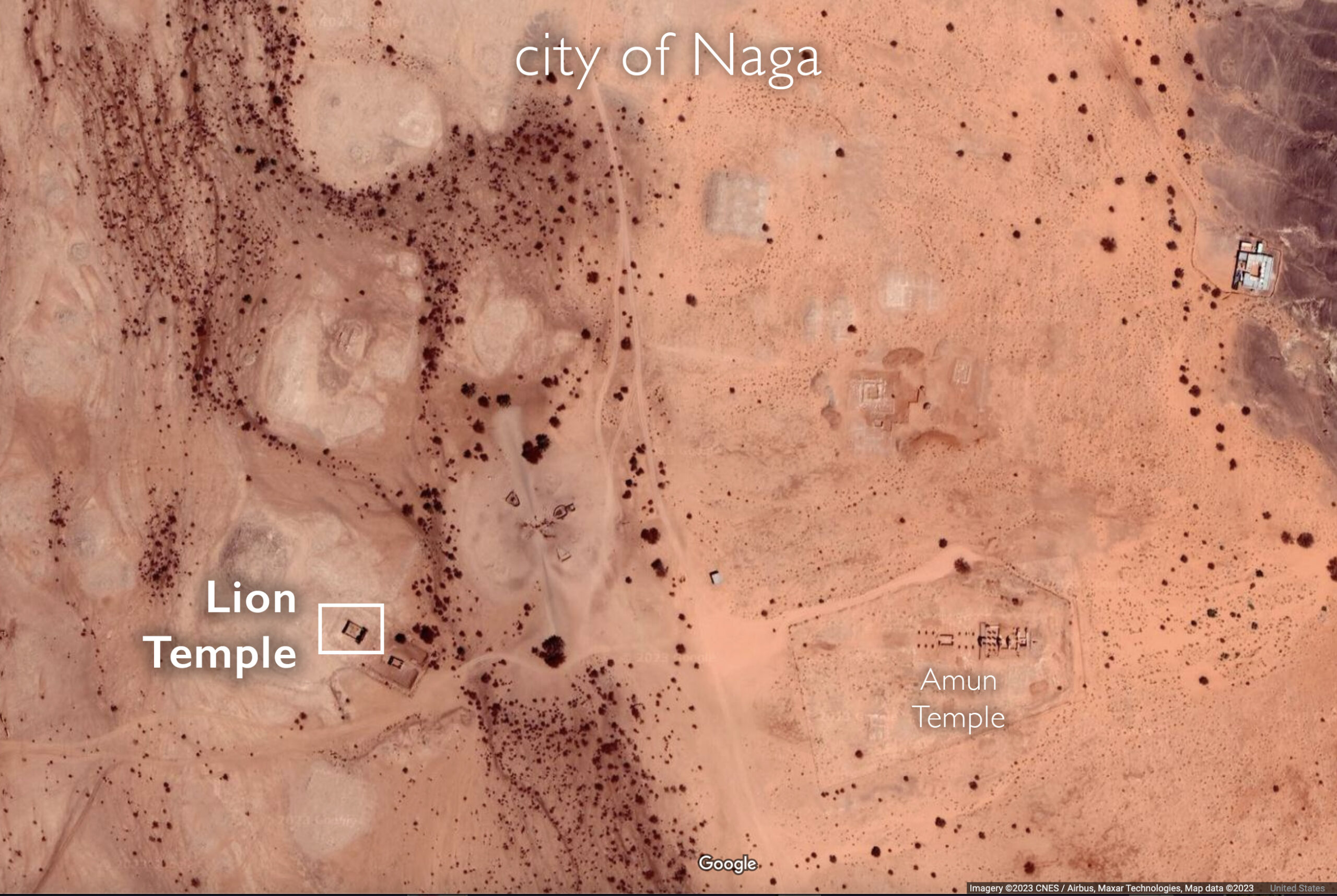
But where Amun was hidden, a god of distant mysteries, Apedemak was near, present in hunt and battle, a god of immediacy and presence. His lion’s face watched over the people, reminding them that divinity was not only in sky or river but also in the strength of the earth beneath their feet. Legends told of his breath scorching the desert, of his roar shaking mountains, of enemies driven into flight by the very sight of his image upon a banner. Yet he was also said to smile upon farmers, bringing rain after drought, guiding herds through lean years, and blessing harvests with abundance. For the lion does not only slay; he also rules, and his pride is family as much as ferocity. So Apedemak’s worship endured, not as the tale of a single act, but as a presence that wove through life. In battle chants he was invoked before warriors clashed, and in the quiet of temples his name was whispered in thanksgiving for strength given and protection kept. He was a god of the threshold: the roar at the frontier, the guardian at the hearth, the king crowned in lion’s light. Though the temples of Nubia would one day fall to silence, the image of the lion-god remained upon their stones, unbroken by time. Even now, travelers who walk among those ruins can see his face carved deep, eyes staring out across the desert, as if Apedemak still watches, ready to rise should his people call again.
A God of southern Nubia unknown in Egypt but depicted in an Egyptianizing style as a lion-headed man, occasionally winged, holding a sceptre with a seated lion on it or as a lion-headed serpent or as a lion, in virtually all cases wearing the elaborate hemhem crown, also called the ‘triple crown’. This crown, whose name means ‘war cry’, consists of three atef crowns or ‘bundles’ mounted on ram’s horns with a uraeus (cobra) on either side, and sometimes additionally with three falcons atop the bundles, each surmounted by a solar disk. The hemhem crown was part of the insignia of the kings of Egypt starting in the Amarna period, and Ptolemaic era kings are frequently depicted wearing it, but it is virtually unknown in Egyptian iconography for a deity to wear this crown (the only exception being Harsomtus). That Apedemak is consistently depicted wearing this crown may therefore indicate that he is to be regarded as embodying the spirit of the Meroitic dynasty. Principally a warrior God, Apedemak can also appear bearing a sheaf of wheat, or in conjunction with solar symbols as indications of the breadth of his providence. Apedemak also appears sometimes riding a lion, and in association with a winged lion who may represent Apedemak himself or a divine agent of his. Apedemak sometimes has the Egyptian Goddess Isis as his consort and Horus as his child. Though the name Apedemak is Meroitic, it was sometimes written in Egyptian hieroglyphs as if it was pꜣ-ir-mky, “the one who makes protection”.
Religion was, however, put to different purposes in the two regions, and for that reason assumed different forms. We know from the evidence of Roman writers as well as from a number of inscriptions in the Temple of Philae (fig. i4) that the favourite deity of Lower Nubia was neither Amon nor Apedemak, but the goddess Isis. She was also worshipped in the southern provinces, and is as often shown in temple reliefs as are several other Egyptian deities. She was not, however, a special tutelary of the ruling family in the same way as were Amon and Apedemak. Indeed, her chief cult centre was not in Meroitic territory at all but on the Island of Philae, in Roman Egypt (fig. I4). Here she was worshipped alike by Romans, Egyptians, Nubians and desert nomads, and her shrine was a centre of pilgrimage from all parts of the Nile Valley. Isis-worship therefore did not, and could not, serve to reinforce the exclusive sovereignty of any one family or monarchy in the same way as did the tutelary cults of Amon and Apedemak in the south. Some of the ruling officials in the north did indeed adopt the title ‘Agents of Isis’ (Millet n.d. 26), but others ignored her and all other deities in their titularies. Once again we are reminded not so much of the ancient world as of medieval Europe, where the sanction of the Church was conferred impartially on several different and sometimes warring monarchies.
It remains to consider what light is shed on political conditions by the villages and cemeteries which comprise the vast bulk of Meroitic archaeological sites in the north. These in their own way are as distinct from the remains in the southern provinces as are the great fortress sites. The village houses are built of mud brick and are so tightly clustered together that even small villages present an ‘urbanized’ and congested appear- ance. Some houses are very sturdily built and regular in design, and seem to be the work of professional builders; many others are more flimsy and irregular. Houses of both kinds are usually found in the same village, as though each community had its elite and its humbler families. Yet both humble and elite houses are supplied with material goods, including luxuries, to an extent which is matched in the south only in the royal and noble tombs. Similar conditions prevail in the Meroitic cemeteries of Lower Nubia. A typical cemetery contains from 50 to 400 graves, which are clustered nearly as tightly as are the village houses. The underground chambers are usually dug out of hard earth banks, without structural reinforcement, but some are walled and vaulted with brick. Preference for one type of chamber over another seems to be determined more by the firmness of the soil than by other factors.
There is some variability in the size of the chambers; some of the larger might hold two or more bodies, while many others would have room only for one. Large tombs were sometimes surmounted by small brick pyramids or platforms at the surface, to which stelae or offering tables might have been attached (though these have usually been displaced by robbers). Despite these indications of social inequities, however, there is no clear typological distinction between the largest and the smallest tombs, and they seem to be randomly distributed through the cemeteries.
Thus, we know from the presence of stelae and offering tables that members of the Wayekiye family – hereditary officials of Lower Nubia for several generations – were buried in the Karanog cemetery (Millet n.d. 77-Io7). Since their stelae a tables were long ago displaced by tomb robbers, however, we now have no way of knowing which tombs at Karanog are actually theirs. This seemingly democratic order- ing of society contrasts sharply with the situation at Meroe, where one cemetery was reserved for the monarchs alone, another for the lesser nobility, and still others (pre- sumably) for the ordinary folk. Widespread material prosperity is even more evident in the graves than in the houses of the Meroitic north.
Although the larger graves typically contain more offerings than do the smaller ones, it is a rare burial which is not accompanied by at least half a dozen objects, often including such imported luxury goods as bronze, faience, glass and ivory. The volume of imported goods found in sites of the late Meroitic period is in fact greater than at any subsequent time in Nubian history down to the twentieth century. Three conclusions may be drawn from our observation of the Meroitic villages and cemeteries of Lower Nubia. First, the unbroken gradation of grave and house types suggests that society was not rigidly stratified on hereditary lines (though the institution of slavery certainly existed, even if it is not attested archaeologically). Second, the wide- spread and fairly equitable distribution of wealth indicates almost certainly that trade was not a monopoly of the state or the elite few, but was widely dispersed in private hands. Finally, the more equitable distribution of wealth in the northern province means also that the average citizen in this political backwater enjoyed a substantially higher material standard of living than did his southern cousin who dwelt in the shadow of the royal court
Significance of the Study
- Apedemak was primarily worshipped in the Kingdom of Kush, especially during the Napatan period when Nubian rulers sought to legitimize their power.
- Iconography of Apedemak often depicts him with a lion’s head and human body, emphasizing his role as a fierce protector and warrior deity.
- Temples dedicated to Apedemak have been found in sites like Napata and Meroe, indicating his significant presence in religious life.
- The worship of Apedemak reflects the militaristic nature of Nubian society, as he was often called upon during times of conflict or war.
- Unlike many Egyptian deities, Apedemak was uniquely tied to Nubian identity, showcasing how local traditions diverged from those of their Egyptian neighbors.
- How does the worship of Apedemak reflect the political and military priorities of the Nubian kingdoms?
- The worship of Apedemak directly mirrors the political and military priorities of the Nubian kingdoms by highlighting their focus on strength and protection in warfare. As a lion-headed god associated with battle, he was invoked by rulers seeking divine support for military campaigns. This reflects a broader societal value placed on martial prowess as essential for maintaining sovereignty against powerful neighbors like Egypt.
- In what ways did Apedemak’s significance differ from that of Egyptian deities such as Amun, particularly in relation to cultural identity?
- Apedemak’s significance differed from that of Egyptian deities like Amun mainly in his strong ties to Nubian cultural identity and local traditions. While Amun was central to Egyptian royal ideology and linked to concepts of creation and divine kingship, Apedemak represented a more localized warrior ethos specific to Nubia. This difference illustrates how the Nubians adapted their religious practices to reinforce their distinct identity while still interacting with Egyptian beliefs.
- Evaluate the role that Apedemak played in the broader context of Nubian interactions with Egypt during ancient times.
- Apedemak played a pivotal role in shaping Nubian interactions with Egypt by serving as a symbol of resistance and autonomy. As Nubians worshipped this fierce deity during conflicts with Egypt, it reinforced their identity and collective memory as warriors. His presence in religious practices not only provided spiritual support but also acted as a unifying figure among the various Nubian kingdoms in their efforts to assert independence against Egyptian dominance. This highlights how local deities could influence political dynamics and cultural resilience in historical contexts.