
Introduction
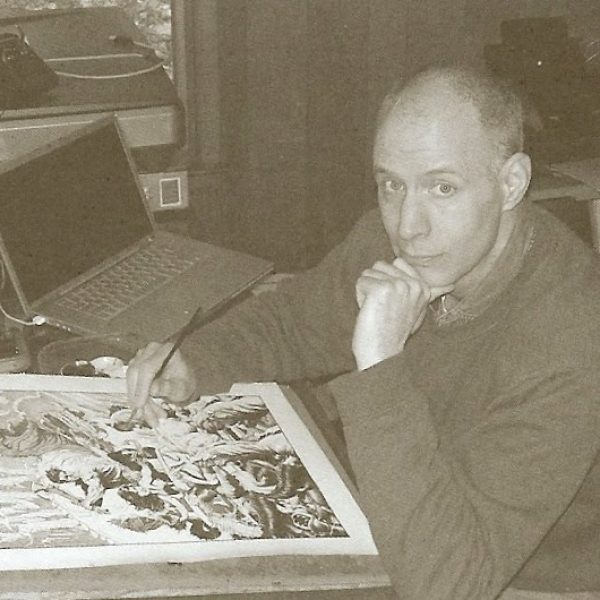
Mark Schultz is an American comic book writer and illustrator best known as the creator of XENOZOIC TALES (aka Cadillacs and Dinosaurs); which is widely considered one of the best (if not THE best) dinosaur comics ever produced.* Schultz graduated from Kutztown University of Pennsylvania in 1977 with a Bachelor’s in Fine Arts. Though a life long fan of comics, Schultz initially had no aspirations to enter the field as a career and originally worked as a commercial illustrator.
In 1974 that changed when Schultz was given the opportunity to ink the backup story in Marvel’s Savage Sword of Conan #132. With the black and white independent comics movement getting underway in the early 1980s, Schultz – unsatisfied with his work as an illustrator – pitched an idea for an original series to indy comics company Kitchen Sink Press.
He cites some of his early influences as old jungle movies shown on television, the work of Edgar Rice Burroughs (including both the Tarzan and Pellucidar series), Robert E. Howard’s Conan, and EC comic books. Wikipedia lists his artistic influences as “Frank Frazetta, Roy Krenkel, and Al Williamson, Wally Wood, Howard Pyle and Joseph Clement Coll.” Schultz has also read extensively on science, evolution, and paleontology, which is clearly evident from the depictions of prehistoric creatures in his books.
The Cadillacs and Dinosaurs comics first appeared in the 1980s, and became popular during the next decade. In the 1990s, a Cadillacs and Dinosaurs video game and animated cartoon appeared, and there were colorized reprints from Marvel Comics. In addition to the stories done by Schultz, there were backup stories in the comics by the late Steve Stiles. And while he did not finish it before his death, famed comic book artist Al Williamson worked on a story set in the world.
Schultz has also done work for Marvel, DC, and Dark Horse, often using company-licensed characters, but sometimes his own creations. In recent years, he has written and drawn Storms at Sea, an illustrated prose book, which might be considered a kind of prequel to the Xenozoic world. And he has produced the Carbon series of art books, which includes not only pen, ink, and brush work, but also pencil illustrations and watercolors.
Schultz currently works on the venerable Prince Valiant weekly comic strip, following in the footsteps of its famous creator, Hal Foster. Schultz worked first as a scripter with Gary Gianni, but since then has taken the lead on the strip, working with Thomas Yeates.
Mark Schultz (born 1955) is an American writer and artist most widely known for the independently published post-apocalyptic comic book tales known under the names Cadillacs and Dinosaurs and Xenozoic Tales. He cites some of his early influences as old jungle movies shown on television, the work of Edgar Rice Burroughs (including both the Tarzan and Pellucidar series), Robert E. Howard’s Conan, and EC comic books. Wikipedia lists his artistic influences as “Frank Frazetta, Roy Krenkel, and Al Williamson, Wally Wood, Howard Pyle and Joseph Clement Coll.” Schultz has also read extensively on science, evolution, and paleontology, which is clearly evident from the depictions of prehistoric creatures in his books.
The Cadillacs and Dinosaurs comics first appeared in the 1980s, and became popular during the next decade. In the 1990s, a Cadillacs and Dinosaurs video game and animated cartoon appeared, and there were colorized reprints from Marvel Comics. In addition to the stories done by Schultz, there were backup stories in the comics by the late Steve Stiles. And while he did not finish it before his death, famed comic book artist Al Williamson worked on a story set in the world.
Schultz has also done work for Marvel, DC, and Dark Horse, often using company-licensed characters, but sometimes his own creations. In recent years, he has written and drawn Storms at Sea, an illustrated prose book, which might be considered a kind of prequel to the Xenozoic world. And he has produced the Carbon series of art books, which includes not only pen, ink, and brush work, but also pencil illustrations and watercolors.
Schultz currently works on the venerable Prince Valiant weekly comic strip, following in the footsteps of its famous creator, Hal Foster. Schultz worked first as a scripter with Gary Gianni, but since then has taken the lead on the strip, working with Thomas Yeates.
Literature Review
The history of the world according to the comic book series Xenozoic Tales. First published in 1986, it postulated that by the then-future year of 1996, a cataclysmic series of geologic upheavals would begin to change the surface of the earth. Things get so bad that by 2020 the planet is no longer habitable and most of the human race is extinguished, along with the rest of life. A few groups of humans, scattered here and there, retreat to underground bunkers in a desperate attempt to survive. When they emerge 500 years later, instead of finding a wasteland, they find a lush ecosystem where every species that has ever walked the planet has been resurrected, from trilobites to mammoths. Also, there’s a second moon. A new geologic era has begun – the Xenozoic Age.
Xenozoic Tales is better known by its nickname, Cadillacs and Dinosaurs, and there are plenty of both throughout its pages. Mark Schultz published 14 issues of the comic before he stopped, mid-story, in 1996. Don’t let that turn you off though. Even half-finished, Xenozoic Tales remains the best dinosaur comic ever published, and in my view, one of the best adventure comics ever to appear.
The series owes a lot to the adventure comics of the 1940s and 1950s, and in early issues Schultz is clearly trying to imitate their art style. (EC Comics is often cited as his source of inspiration.) Set on the transmogrified east coast of North America, the story centers around Jack “Cadillac” Tenric, who is an odd cross between an auto mechanic and a forest ranger.
Tenric uses his skills to rebuild 20th century machinery – particularly Cadillacs – and to protect the surrounding wildlife from the predations of human poachers. Not much is known about the cataclysm that changed the world other than it was brought about by humanity’s mistreatment of the environment, and Tenric’s job is to make sure his “tribe” doesn’t repeat those past mistakes.
Trouble comes in the form of the beautiful Hannah Dundee, an ambassador from the neighboring city-state of Wassoon. The dangerous environment of the Xenozoic Age makes communication between the surviving remnants of humanity difficult, and while she is welcomed, the leaders of Tenrec’s tribe are suspicious about Dundee’s motives.
Tenric and Dundee have a rocky relationship, with Tenric a little too hotheaded for his own good and Dundee too secretive about her real mission among his people, but there is sexual tension between the two from the start. Together they explore the Xenozoic’s mysteries: What exactly caused the cataclysm? How did the strange ecosystem come to be? And who are the Grith?
Xenozoic Tales is a black-and-white comic that shows in the world of comics, color can be overrated. Schultz’s art style evolves over the series’ 14 issues, starting from simple-but-promising drawings in the first few issues to a fully organic and exquisitely detailed style by the last issues. His dinosaurs also evolve over the course of the comic. Science-literate readers will likely be disappointed with the tail-dragging saurians appearing in the first issues, but they will notice that in later issues his dinosaurs catch up to modern thinking, yet retain a Charles R. Knight-vibe at the same time. Steve Stiles supplies the art for the short stories appearing at the end of each issue that flesh out the invented world, but his own style is rather clunky compared to Schultz’s work.
The stories themselves are well-told, with better-than-average characterization and plenty of action. My main complaint with the series is that it ends mid-story, with no resolution to the mysteries it raises. Schultz recently announced he was working on a new Xenozoic Tales graphic novel, but whether it is a continuation of the series or a separate story set within the comic’s universe remains to be seen.
at, at least, is the history of the world according to the comic book series Xenozoic Tales. First published in 1986, it postulated that by the then-future year of 1996, a cataclysmic series of geologic upheavals would begin to change the surface of the earth. Things get so bad that by 2020 the planet is no longer habitable and most of the human race is extinguished, along with the rest of life. A few groups of humans, scattered here and there, retreat to underground bunkers in a desperate attempt to survive. When they emerge 500 years later, instead of finding a wasteland, they find a lush ecosystem where every species that has ever walked the planet has been resurrected, from trilobites to mammoths. Also, there’s a second moon. A new geologic era has begun – the Xenozoic Age.
The series owes a lot to the adventure comics of the 1940s and 1950s, and in early issues Schultz is clearly trying to imitate their art style. (EC Comics is often cited as his source of inspiration.) Set on the transmogrified east coast of North America, the story centers around Jack “Cadillac” Tenric, who is an odd cross between an auto mechanic and a forest ranger.
Tenric uses his skills to rebuild 20th century machinery – particularly Cadillacs – and to protect the surrounding wildlife from the predations of human poachers. Not much is known about the cataclysm that changed the world other than it was brought about by humanity’s mistreatment of the environment, and Tenric’s job is to make sure his “tribe” doesn’t repeat those past mistakes.
Trouble comes in the form of the beautiful Hannah Dundee, an ambassador from the neighboring city-state of Wassoon. The dangerous environment of the Xenozoic Age makes communication between the surviving remnants of humanity difficult, and while she is welcomed, the leaders of Tenrec’s tribe are suspicious about Dundee’s motives.
Tenric and Dundee have a rocky relationship, with Tenric a little too hotheaded for his own good and Dundee too secretive about her real mission among his people, but there is sexual tension between the two from the start. Together they explore the Xenozoic’s mysteries: What exactly caused the cataclysm? How did the strange ecosystem come to be? And who are the Grith?
Xenozoic Tales is a black-and-white comic that shows in the world of comics, color can be overrated. Schultz’s art style evolves over the series’ 14 issues, starting from simple-but-promising drawings in the first few issues to a fully organic and exquisitely detailed style by the last issues. His dinosaurs also evolve over the course of the comic. Science-literate readers will likely be disappointed with the tail-dragging saurians appearing in the first issues, but they will notice that in later issues his dinosaurs catch up to modern thinking, yet retain a Charles R. Knight-vibe at the same time. Steve Stiles supplies the art for the short stories appearing at the end of each issue that flesh out the invented world, but his own style is rather clunky compared to Schultz’s work.
The stories themselves are well-told, with better-than-average characterization and plenty of action. My main complaint with the series is that it ends mid-story, with no resolution to the mysteries it raises. Schultz recently announced he was working on a new Xenozoic Tales graphic novel, but whether it is a continuation of the series or a separate story set within the comic’s universe remains to be seen.
Jack Tenrec, adept in the ancient art of automobile mechanics, was the hero. Technology had generally been set back by the upheaval, but bits and pieces of it survived here and there, including the fleet in Jack’s large garage, which leaned heavily toward Jack’s own favorite model — those big ol’ mid-20th century Cadillacs, which he acquired and restored with alacrity. Oil wasn’t being refined anymore, but he was able to modify them to run on dinosaur guano. “You get used to the smell,” he observed, which can also be said of gasoline.
Romance potential was provided by Hannah Dundee, who came to Jack’s locale ostensibly on a diplomatic mission, to persuade Jack to stop chasing criminals into his neighbors’ territory. She also had an educational mission, to teach farming methods. Her third mission wasn’t publicly known — it was to raid the carefully preserved local library for any knowledge she could get out of it. She and Jack had a complicated relationship where they were sometimes allies and sometimes at odds. If you saw it on TV, you’d expect them to be an “item” by about the third or fourth season.
Cartoonist Schultz introduced the scenario in a 12-page comic book story titled “Xenozoic!”, which appeared in the eighth issue (December, 1986) of Death Rattle, an anthology of non-series science fiction, fantasy and horror. The word “xenozoic” is constructed like the names of geological eras such as paleozoic (“old life”) and mesozoic (“middle life”). Parsing it out yields “strange life”. The publisher was Kitchen Sink Press, which started in underground comix, publishing the likes of Skip Williamson’s Snappy Sammy Smoot and Jay Lynch’s Nard ‘n’ Pat, but by ’86 had branched out into mainstream masterpieces like The Spirit and Steve Canyon.
“Xenozoic” moved immediately into a regular series of its own. Xenozoic Tales #1 had a cover date of February, 1987. It didn’t come out as often as most comic books from major publishers, because Schultz, a meticulous illustrator with a style heavily influenced by such EC Comics stars as Al Williamson (Flash Gordon) and Wallace Wood (T.H.U.N.D.E.R. Agents), didn’t churn out the stories on a rigid monthly schedule, and he chose to do the main story in each issue. (He did, however, let some of the back-page stories be drawn by Steve Stiles, whose work also appeared in Anarchy Comics and Commies from Mars.) Still, 14 issues came out between 1987 and ’96, with a 3-D edition in 1992. The blurb “Cadillacs and dinosaurs”, which was eventually to replace the title, was first seen on the cover of the second issue.
The first Xenozoic trade paperback, which collected issues 1-4, plus the Death Rattle story, was published under the “Cadillacs & Dinosaurs” title. It came out in 1989 and remained in print for several years. In 1991-92, Marvel Comics’ “Epic” imprint, which published creator-owned properties such as Groo the Wanderer, reprinted Xenozoic stories in a six-issue mini-series, again using the “Cadillacs & Dinosaurs” title. That was also the name of the video game, which came out in 1992.


