
Introduction
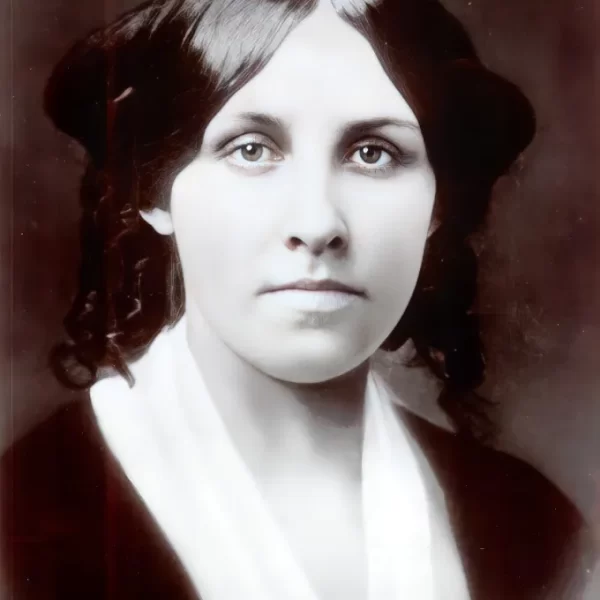
Louisa May Alcott was an influential American author and social reformer, best known for her seminal novel “Little Women,” published in 1868. Born on November 29, 1832, in Germantown, Pennsylvania, Alcott grew up in a progressive household that championed education and abolitionism, which shaped her storytelling and themes of female empowerment. Despite facing financial hardships and societal constraints as a woman in the 19th century, she carved out a successful literary career, drawing from her own experiences and the lives of her family, particularly her sisters. Alcott’s works, imbued with her sharp wit and keen observations of everyday life, continue to resonate with readers today, making her a beloved figure in American literature and a pioneer in portraying strong, independent female characters.
Literature Review
Little Women is written by American author Louisa May Alcott. And the story of the Marches happened in Massachusetts during the American Civil War. It includes most problems which probably happen in the growth of four sisters, such as the problems in first love, friendship between teenagers and the gap between the dream and the reality. Learned from the growth story of four sisters, we find that the four sisters are different. They have different characters, hobbies, thoughts, and personalities, and at last they have different lives, results, and destinies. Although Father March is away with the Union armies, the sisters Meg, Jo, Amy, and Beth keep in high spirits with their mother, affectionately named Marmee.
“Little Women” tells the heartfelt and sometimes bittersweet story of the four March sisters as they grow up during the American Civil War in Massachusetts. Loosely inspired by Alcott’s own life in Concord, the novel explores the sisters’ journey through childhood, love, loss, and self-discovery.
The story begins just before Christmas when the March family is struggling financially since their father, Mr. March, is away serving as a Union chaplain in the war. The girls—led by their loving mother, Marmee—are initially feeling sorry for themselves, but after receiving a letter from their father, they decide to make the most of their situation. Instead of buying gifts for themselves, they purchase presents for Marmee. On Christmas morning, they selflessly give away their breakfast to the starving Hummel family, and in return, their wealthy neighbor, Mr. Laurence, surprises them by sending over a grand feast.
As the story progresses, each sister’s unique personality is revealed. Meg, the eldest, longs for a life of luxury and comfort, while Jo, dreams of becoming a famous writer. Beth, the shy and gentle sister, is happiest at home, tending to the family and playing the piano. The youngest, Amy, who is a bit spoilt, dreams of wealth and social refinement. Despite their differences, the sisters share a deep bond and lean on one another as they face the ups and downs of life.
Things change when Jo and Meg attend a New Year’s Eve party hosted by Meg’s wealthy friend, Sally Gardiner, where Jo meets Laurie, Mr. Laurence’s charming grandson. The two quickly become close friends, and Laurie soon becomes a part of the sisters’ world. His playful relationship with Jo leads many to believe they will eventually marry, though their story takes a different turn.
During the same period, Beth forms a special friendship with Mr. Laurence, who gifts her his late granddaughter’s piano. Meanwhile, Amy faces trouble at school for trading limes, which leads Mrs. March to pull her out after a very harsh punishment. Tensions between Amy and Jo also flare when Amy, angry after Jo refuses to take her to the theater, burns Jo’s manuscript. The sisters reconcile after a near-tragic incident when Amy falls through thin ice while skating and Jo, with Laurie’s help, rescues her.
The family’s world is then disrupted when they receive news that Mr. March has fallen ill in Washington, D.C. Jo, always the one to sacrifice for her family, cuts off her long hair and sells it to help fund Marmee’s trip to care for their father. While Marmee is away, only Beth continues to visit the Hummel family, but this act of kindness results in Beth contracting scarlet fever, leaving her seriously ill. To avoid infection, Amy is sent to live with Aunt March, while Marmee rushes to return home and help nurse her back to health.
In the second part of the story, the Civil War has ended. Meg marries John Brooke, Laurie’s tutor, though she soon finds that managing a household and raising twins, Demi and Daisy, is far more challenging than she anticipated.
Amy, now more mature, is invited to travel to Europe with Aunt Carroll, leaving Jo, who had hoped to take the trip herself, behind. Feeling disappointed and restless, Jo moves to a boarding house in New York to broaden her horizons. It is there that she meets Professor Friedrich Bhaer, an older, intellectual German man who has come to America to take care of his sister’s orphaned children. Mr. Bhaer challenges her to write from the heart. His influence leads Jo to abandon the sensational stories she had been writing and focus on more meaningful work.
When she returns home, Laurie, who has always had deep feelings for Jo, proposes to her, but she turns him down, explaining that she cannot love him romantically. Heartbroken, Laurie travels to France, where he reconnects with Amy. Over time, the two fall in love, much to the surprise of us all. Their eventual marriage marks the start of a new chapter for both characters.
Sadly, Beth’s health, already weakened by scarlet fever, continues to decline, and she eventually dies, leaving the family devastated. Jo is especially heartbroken, as she had always felt a special responsibility for her younger sister. Beth’s death serves as a reminder of the fragility of life and forces the remaining sisters to reflect on what truly matters—family, love, and the importance of cherishing the time they have together.
By the end of the novel, each of the remaining March sisters has found her own path. Meg is settled into her role as a wife and mother, Amy and Laurie are happily married, and Jo has found love with Mr. Bhaer. After Aunt March passes away, Jo inherits her large home, Plumfield, which she and Friedrich transform into a school for boys, allowing Jo to fulfill her desire to make a difference in the world.
Little Women concludes with the March family reunited, reflecting on their hardships and triumphs. The novel’s themes of love, sacrifice, independence, and the bond of sisterhood resonate across generations, making it a timeless story that continues to capture the hearts of readers worldwide.
Jo is creative and love writing. Meg is noble, vain, and love writing plays, acting, and housekeeping. Beth has the spirit of sacrifice, and love playing the piano. Amy is graceful and selfish, and love painting. However, despite their efforts to be good, the girls show faults: The pretty Meg becomes discontented with the children she teaches; boyish Jo loses her temper regularly; while the golden-haired schoolgirl Amy is inclined towards affectation. However, Beth, who keeps the house, is always kind and gentle. Maybe their different characters decide their different destinies.
Jo’s Characters and Destiny When we first meet Jo March, she’s a tomboyish, hot-tempered, geeky fifteen-year-old girl. She loves activity and can’t bear to be left on the sidelines; it drives her crazy that she can’t go and fight in the Civil War alongside her father, who has volunteered as a chaplain. Instead, Jo has to stay at home and try to reconcile herself to a nineteenth-century woman’s place in the domestic sphere, which is extremely difficult for her. You can hear the trouble in her name—she’s called Josephine, a feminine name, but she goes by the more masculine-sounding Jo. She’s clumsy, blunt, opinionated, and jolly. Her behavior is often most unladylike—she swears (mildly),
burns her dress while warming herself at the fire, spills things on her only gloves, and barely tolerates her cranky old Aunt March. She’s so boyish that Mr. March has referred to her as his “son Jo” in the past, and her best friend Laurie sometimes calls her “my dear fellow”. Jo also loves literature, both reading and writing. She composes plays for her sisters to perform and writes stories that eventually were published. She imitates Dickens and Shakespeare and Scott, and whenever she’s not doing chores she curls up in her room, in a corner of the attic, or outside, completely absorbed in a good book. Jo hopes to do something great when she grows up, although she’s not sure what that might be—perhaps writing a great novel. Whatever it is, it’s not going to involve getting married; Jo hates the idea of romance, because marriage might break up her family and separate her from the sisters she adores. As you might have guessed, Jo is being set up for a Meaningful Journey of Self-Discovery and Surprises. By the end of the novel, her dreams and dislikes are going to be turned topsy-turvy; her desire to make her way in the world and her distaste for staying at home will be altered forever. She may not find romance in the places that readers expect, but she will find it. She’ll also realize that romantic love has its place, even though it changes the relationships you already have. As Jo discovers her feminine side, she also figures out how to balance her ambitious nature with the constraints placed on nineteenth-century women. These constraints reflect the contemporary situation of twenty-first-century women readers.
Meg’s Characters and Destiny Meg, short for Margaret, is the oldest and (until Amy grows up) the prettiest of the four March sisters. She’s also the most typical of the sisters—we think of her as everything that you might expect a nineteenth-century American girl from a good family to be. Meg loves luxury, nice things, dainty food, and good society. She’s the only sister who can really remember when her family used to be wealthy, and she feels nostalgic about those good old days. Her dream is to be wealthy once more and have a huge mansion with lots of servants and expensive possessions. She’s also a bit of a romantic. When she has to tell a story to amuse her sisters, it’s about love and marriage, and Jo starts to suspect pretty early on that Meg might have a real-life Prince Charming in her thoughts. Meg is sweet-natured, dutiful, and not at all flirtatious—in fact, she’s unrealistically good and proper. Perhaps that’s why she’s so alarmed by her sister Jo’s rambunctious, tomboyish behavior. Each of the March sisters has at least one major character flaw that she struggles to overcome, and Meg is no different. Meg’s problem is, well, avarice, greed, envy, wanting stuff that other people have. Whatever you call it, she’s got it in spades. Meg tries to set aside her materialism, and gradually learns to value simple things more because of the hard work that it takes to earn them. Before she gets to that point, however, she spends many, many hours envying the fortune and leisured life of her friends Sallie Gardiner and the Moffat girls. In fact, at one point Meg allows the Moffats to dress her up in fancy clothes, covering her in makeup and jewelry and making her show far more cleavage than a demure, Protestant, nineteenth-century girl really should. She even—we know you’ll be horrified here—drinks champagne at one point! It only takes Meg one bout of this kind of vanity and wealth-worship to realize that the people she’s trying to impress are unbelievably shallow. She doesn’t feel like herself, and when she hears someone at the party say that she’s dressed up like a doll, she realizes that’s exactly what she’s turned herself into, and she never does it again. Even at her wedding, Meg wears a simple dress that she makes herself by hand.
Beth’s Characters and Destiny Beth is one of those children in a novel who is so good and sweet and perfect that you just know she’s going to die, because nothing interesting could ever happen to her, and anyone that angelic belongs in Heaven—like Little Nell in The Old Curiosity Shop or Eva in Uncle Tom’s Cabin. OK, sorry if we spoiled that one for you, but seriously: Beth is happy and content at home, too shy to go to school or go out in the world, and spends her time doing sweet little things around the house to make her family, her pet cats, and even her dolls happy and comfortable. She’s doomed. She has no ambitions, no desires, doesn’t dream about getting married, and thinks about God and Heaven a lot. These are all the signs that a nineteenth-century author uses to tell you that a kid is not long for this world. The only thing that really surprises us is that she survives her first bout of scarlet fever and doesn’t die until the second half of the novel. Beth’s only earthly love is music. She adores playing the piano and singing, and the only material thing that she wants is a nicer piano, since her family’s is old and out of tune. The piano that she longs for is provided by her wealthy neighbor, old Mr. Laurence, who gives her his dead granddaughter’s old piano. If you were still missing out on the signs that Beth is going to die, then you should get suspicious when you find out that Beth reminds Mr. Laurence of the little granddaughter he had who died young. Beth shares this anonymous girl’s musical talent—and, by the logic of the sentimental novel, she’s also going to share her early demise. Of course, Beth’s love of music isn’t that earthly, either. She mostly sings hymns, and her connection to such an ethereal art form
also reinforces the idea that she belongs in Heaven, not in the parlor. What we’re trying to say is that Beth is the little-girl version of a nineteenth-century stock figure called the “angel in the house”. The phrase “angel in the house” is the title of an 1854 poem by an author called Coventry Patmore (If you’re keeping score, that means the poem came out fourteen years before the first part of Little Women, so it was definitely circulating in popular culture when Alcott’s novel appeared). The poem itself is one of the few pieces of literature that we actually don’t recommend—although you can read it here if you really want to—but basically it’s about housewives, and how they should be these perfect, patient, personality-less, submissive domestic goddesses who make little safe nests for their hard-working hubbies and never, ever have opinions or needs of their own. The “angel in the house” figure defines everything that women were supposed to be in the latter half of the nineteenth century, and Beth, despite her youth and the fact that she doesn’t get married, is definitely a sample of this tradition. Just to be clear, we don’t want to rag on housewives and other men and women who stay at home to take care of the family. The stay-at-home people we know work really hard and play a crucial role for their families and society. But, you know, we think they should be allowed to have opinions, and vote, and stuff, not just toss their curls and say “whatever you think, honey”. Anyway, back to Beth. Although she dies just as she reaches adulthood, Beth has a significant effect on the people around her, especially her sister, Jo. As Jo nurses Beth through her final illness, she realizes how important domestic duties really are. Jo resolves to take over Beth’s role as the glue that holds her family together, caring for her parents and cherishing the everyday tasks that Beth did so lovingly. In this way, Beth’s example lives on, although perhaps with a little more spice and a little less sugar. Amy’s Characters and Destiny Amy is the March sister that most readers love to hate. She’s the youngest of the family and she fits the stereotype of the spoiled youngest child. Amy’s vanity begins with her appearance—she’s a pretty child and turns into a beautiful, stately woman, with lovely golden hair and blue eyes. The only thing that bothers her is that her nose isn’t quite aristocratic-looking enough—it’s a little snub nose, instead of a stately Roman nose. You can bet that if Amy had lived in an era of plastic surgery, she’d have gone in for a nose job. As it is, she has to try to reshape her nose herself by wearing a clothespin on it while she’s sleeping. Amy’s anxiety about her nose, however, is just the beginning of her obsession with all things upper-class. Amy’s great ambition is to be a gentlewoman. She tries to make the most of her clothes and accessories, cultivates grace and politeness, and makes social calls on the family’s wealthy friends and neighbors. She’s pretty successful at it, too. Amy’s interest in high society might be shallow, but her kind heart is deep, and people appreciate her classy behavior. As a child, her ambitions seem ridiculous—she’s always misusing big words and affecting little snobby behaviors. Sometimes she even shows signs of a violent temper, such as when she burns one of Jo’s manuscripts in revenge for being left at home while her sisters and Laurie attend a play. And she’s also overly sensitive, possibly even spoiled—one punishment for breaking the rules at school is enough to make her resolve never to go back. But when she grows into a woman, Amy is far more genteel, and she’s a big hit, both at home and abroad.
In fact, it’s Amy’s decorous behavior that convinces her Aunt to take her to Europe and her Aunt March to pay for the trip. Amy hopes to use her European adventure to cultivate and refine her artistic skills. From childhood on, Amy’s tried every kind of visual art there is, from painting to sketching to sculpting. Most nineteenth-century young women dabbled in these arts, but Amy hopes to make a career out of them. In fact, she wants more than a career; she wants to do the work of genius. Eventually, Amy has to admit to herself that, while she’s talented, she doesn’t have that special extra inspiration that would mark her as a true artist. Instead, she contents herself with fashioning her life artistically. It’s easy for Amy to turn her focus from her art to her life when Laurie arrives in Europe and starts hanging out with her. Freed from the patterns of interaction that were set for them by the family dynamic back home, Amy and Laurie discover each other anew. Laurie realizes that Amy is exactly the kind of graceful, principled woman who would make a good wife for him, and Amy realizes that Laurie’s strength and comfort mean more to her than anyone else’s ever could. Sadly, this disrupts Amy’s plan to be a gold-digger and marry the wealthy Fred Vaughn for his money. But, as Marmee’s daughter, Amy was always destined to realize that love means more than money, and that respect is also important.
Significance of the Study
With the demise of this relationship, the sexual boundaries within Little Women are no longer blurred and the hegemonic social order is fully restored. Patriarchy may ultimately conquer in Little Women, but for how long? Whilst it may appear that Little Women remained within its conservative roots and ultimately reinforced gender norms and heterosexual relations, one needs to finally place the novel within its historical context. Its place within the nineteenth century domestic novel genre, whose sentimental message focused on slavery, Christianity or female piety and suffrage,2 allows us to appreciate that Little Women was and remains a radical novel that flies just under the radar of censorship and succeeds in its attempt to question the sexual conventions and stereotypes of the later part of the nineteenth century. Millet acknowledges, “because of our social circumstances, male and female are really two cultures” (31). However, through these provocative reconsiderations that render a feminist reading of Little Women and enhance our understanding of the novel in terms of both its sexual ambiguousness and the suppression of female sexuality through compulsory heterosexuality, one is able to appreciate that, to a certain extent, we no longer have to accept the viewpoint that men and women are of two different cultures. By engaging with contemporary theories and applying them not only to Little Women, but also to other classic or canonical texts, this idea of two cultures is able to be challenged. Through the widening of our understanding of “sexuality” in contemporary society, we are able to acknowledge that sexuality is no longer just about reproduction, but also about our own personal identity and individual happiness.
Little Women was written in 1868 at a time when the unified belief towards sexuality was “to ensure population, to reproduce labor capacity, to perpetuate the form of social relations…to constitute a sexuality that is economically useful and politically conservative” (Foucault, 37). Women were seen as virtuous, pure and asexual. Sexual activity amongst women was understood as something to be endured to gratify their husbands or to procreate, it was not something that was willingly embarked upon. Family remained the chief patriarchal institution and the social order within society determined that males ruled over females. Excluded from this public sphere of patriarchy, where male values were exercised, women were united within the matriarchal domestic sphere of housekeeping and childrearing. There was little that tied the two sexes together and whilst women may have depended on men financially, it was women that they turned to emotionally. Men had to be seen as repressing any emotions in favour of rationality and therefore women, through inhabiting the same sphere, were allowed the freedom to express their sentiments of the heart, their emotions and their passions unreservedly. As several critics have pointed out, the social acceptability and even fashionableness of homo-social or romantic friendships, which encouraged women to fall “passionately in love with each other” (Faderman, 74), whilst refusing to accept that these relationships were anything other than platonic, further appropriated women’s subjugation and nonsexuality. Women could unselfconsciously confess their love for another woman safe in the knowledge that “regardless of the feeling that might develop between them, they need not attribute it to the demon, sexuality, since women supposedly had none” (Faderman, 159). This dichotomy between covert female sexuality and overt female asexuality goes some way to explain the sexual ambiguousness of Little Women.
suggest that the lesbianism evident within Little Women is related to what Adrienne Rich terms the “lesbian continuum” of women identified experiences and the love of a female community. For Rich, the term “lesbian continuum” refers to “a range – through each woman’s life and throughout history – of woman-identified experience; not simply the fact that a woman has had or consciously desired genital sexual experience with another woman…to embrace…primary intensity between and among women, including the sharing of a rich inner life” (Rich, “Compulsory Heterosexuality”, 649). In addition, when referring to the bonds of sisterhood Maya Angelou comments that “all the responsibility, all the courtesy, all the soft and sweet words, all the teaching words, are called for in those relationships as much as in a love affair” (Angelou, 135). Therefore, Jo’s transgressiveness and bi-sexuality allows her to explore this female community of matriarchal love and sisterhood. Consequently, her desire to “marry Meg myself, and keep her safe in the family”(Alcott, 203) is not because she has passionate desires for her sister, but because she fears losing this female sanctuary in favour of forced male identification. Similarly, her longing for them to all be boys is also due to the fact that her sister, as a result of an enforced compulsory heterosexuality, will lose her own identity to her husband and therefore Meg’s affection for her will be lessened: “For Jo loved a few persons very dearly, and dreaded to have their affection lost or lessened in any way”(Alcott, 233).
Early in Little Women, Jo March’s “queer performances” scandalize her sister Meg (47). 1 Alcott often uses the word queer to describe Jo’s (and her own) nonconformist behavior, but the adjective provides the twentieth-century reader with a punning metaphor that aptly sums up one of the most subversive elements of the novel, and the noun prefigures Judith Butler’s arguments about the performative nature of gender. As Butler puts it, “That the gendered body is performative suggests that it has no ontological status apart from the various acts which constitute its reality.” 2 Later, she advises her reader to think of gender “as a corporeal style, an ‘act,’ as it were, which is both intentional and performative, where ‘performative’ suggests a dramatic and contingent construction of meaning.” 3 Thus, Butler argues, gender is not a biological construct; it is a social one. Jo’s most blatant act of non-conformism is her rejection of socially inscribed heterosexual gender roles; the text often describes her “performances” in masculine terms to express her androgynous nonconformity. 4 In Jo’s refusal to perform her prescribed gender role lies a critique of heterosexuality that can be read as a strong affirmation of lesbian politics.
Top of Form