
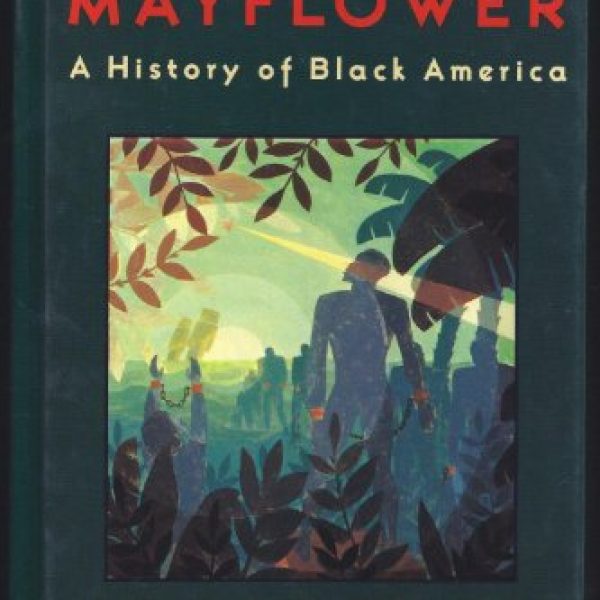
Introduction:
The historian and journalist Lerone Bennett Jr. passed away on February 14, 2018, at age 89. Born in Clarksdale, Mississippi, he and his family moved to Jackson when he was young. An avid black reader in the age of white supremacy, he had the good fortune of finding a white used-book seller who allowed him to read when the store was closed. His love of history took a serious turn when he discovered a volume of Lincoln’s writings and speeches that challenged the image of the Great Emancipator. A revisionist historian was born.
At Morehouse College, Bennett majored in history, graduating in 1949. After serving in the Korean War, he began his career at the Atlanta Daily World, but before long joined Johnson Publishing Company in Chicago. He worked first for Jet and then for Ebony, becoming the executive editor in 1958. Bennett’s close relationship with company owner John H. Johnson underwrote the journalist’s historical ambitions. With a circulation that peaked at 2 million, Johnson’s Ebony and his book division made Bennett’s works common in black homes.
During the 1960s, Johnson’s editor became the black community’s historian. In 1961, amid the Civil Rights Movement, Bennett authored a popular black history series in Ebony that became the basis for his general history, Before the Mayflower (1962). Historian Benjamin Quarles noted “its unusual ability to evoke the tragedy and the glory of the Negro’s role in the American past.” In 1964, Bennett wrote a biography of his Morehouse classmate: What Manner of Man: A Biography of Martin Luther King. He told the story of the first blacks to exercise political power in Black Power U.S.A.: The Human Side of Reconstruction 1867–1877 in 1967. The following year brought Pioneers in Protest.
Bennett was much more than a popularizer. He captured the zeitgeist of the black baby boomers and led the shift from “Negro” to “black.” His books brimmed with militant black people who questioned the promise of America and protested their treatment, displacing the patient, patriotic Negroes who longed for citizenship. Before young scholars could come out of the archives and focus on the black protest tradition, Bennett had culled the secondary literature and printed primary sources, and put the new interpretations before the black public. He became a beacon for young scholars associated with the Black Power generation.
When he returned to his initial interest in Lincoln, Bennett found a much less receptive public, especially among academics. In 2000, Johnson Publishing released Forced into Glory: Abraham Lincoln’s White Dream. For years, he had treated Abraham Lincoln as a white supremacist, but now he viewed Lincoln’s every act to advance black freedom and equality as a grudging concession to reality. Negative reviews followed, and few treated his work as a needed corrective. While Bennett relished his engagement with the overwhelmingly white community of Lincoln scholars, he prized both support of and opposition to his views from within the black community. He spoke most fondly of his black readers who would see him on the speaking circuit and wholly reject his interpretation of Lincoln, as theirs was the view he sought to challenge his entire life.
Bennett’s scholarly home was the Association for the Study of Negro Life and History, founded by Carter G. Woodson more than a century ago. Not surprisingly, Bennett played a leading role in changing “Negro” in the association’s name to “Afro-American” in the early 1970s. Like John H. Johnson, who served on the board in the 1950s, Bennett used his renown to support the association. In the early 1980s, he served as vice president, and in the mid-1990s as a council member. In 2003, the association awarded him its most prestigious scholarly award, the Woodson Medallion
Literature Review:
Book Summary:
A detailed history and analysis of African American history in the United States.
The Black experience in America — starting from its origins in western Africa up to the present day — is examined in this seminal study by Lerone Bennett Jr. The entire historical timeline of African Americans is addressed, from the Colonial period through the civil rights upheavals of the 1960s and 1970s.
The Black experience in America — starting from its origins in western Africa up to the present day — is examined in this seminal study by Lerone Bennett Jr. The entire historical timeline of African Americans is addressed, from the Colonial period through the civil rights upheavals of the 1960s and 1970s.
Before the Mayflower grew out of a series of articles Bennett published in Ebony magazine regarding “the trials and triumphs of a group of Americans whose roots in the American soil are deeper than the roots of the Puritans who arrived on the celebrated Mayflower a year after a ‘Dutch man of war’ deposited twenty Negroes at Jamestown.” Bennett’s history is infused with a desire to set the record straight about Black contributions to the Americas and about the powerful Africans of antiquity.
Significance of the Study
1. The African Past A series of discoveries has revolutionized our understanding of Africa, previously labeled the “Dark Continent,” now recognized as humanity’s cradle. Ancient Africans contributed significantly to civilization, particularly in Egypt and powerful states in the Sudan. Findings from archaeological sites like Olduvai Gorge and the Nile Valley reveal that Africans were among the first to use tools, cultivate crops, and create art.
A. Important Discoveries: – Olduvai Gorge: Evidence suggests humans originated in Africa, using tools that later spread worldwide. – Nile Valley and Sudan: African peoples laid the foundation for Egyptian civilization, with early cultures exhibiting sophisticated skills in pottery and agriculture. – Congo and Sahara: Art and mathematical tools indicate advanced societal development long before European influence.
B. Historical Significance: Ancient peoples viewed blackness positively, with Egyptians depicting themselves in varying skin tones, suggesting diversity in their society. Many scholars argue that a significant portion of early Egyptians had African lineage, as studies of skeletal remains indicate a mixture of ethnic backgrounds.
C. Ethiopia’s Role: Ethiopians claimed ancestry linked to Egyptian civilization and held significant cultural authority, with powerful kings leading conquests and cultural revivals, such as those during the reign of Taharka.
2. Before the Mayflower In August 1619, a ship known for piracy arrived in Jamestown, Virginia, carrying Africans—Antony, Isabella, and others—marking the beginning of Black history in America. Antony and Isabella’s love story gave rise to the first recorded African American child.
A. The Slave Trade: This chapter of history narrates the African slave trade, which caused the loss of millions. It involved brutality and exploitation, with African families torn apart and individuals dying during capture or transit.
B. Early African Settlers: The first Africans in America were not initially treated as slaves; they were part of a system akin to indentured servitude. Over decades, their status shifted from that of equals with whites to enslaved individuals by the mid-1660s, driven largely by economic demands and the institution of racial slavery.
C. The Rise of Slavery: Racial laws emerged that dehumanized Africans and established lifelong servitude, escalating the population of enslaved individuals in the colonies. The British-Protestant colonies became known for their oppressive treatments, leading to profound social and economic consequences that saw a spike in the slave population.
D. Global Impact: The slave trade reshaped societies both in Africa and the Americas, creating a legacy of suffering and racial tension that persists today. The slave trade fueled economic prosperity in Europe and established social hierarchies predicated on race, with Africans contributing significantly to cultural life in the Americas despite their circumstances. The narrative distills the richness of African heritage and the stark realities of the slave trade, illustrating a history intertwined with both dignity and suffering that laid foundational elements of America’s socio-economic landscape.
Chapter 2 Summary: Before the Mayflower Introduction to the Slave Ship at Jamestown – The chapter begins with a description of the ship that arrived in Jamestown, Virginia, in August 1619, carrying the first enslaved Africans, including Antony and Isabella. This marked the start of the African presence in America.
The Start of the Slave Trade – The European slave trade began in 1444, leading to approximately 40 million Africans being affected over four centuries, with 20 million transported to the New World. – The chapter illustrates the trade as a profound human tragedy rather than mere statistics, emphasizing the individual lives affected and the horrors they faced.
Captains and Stories of Enslaved Africans – Several personal stories exemplify the cruelty of the slave trade, including tales of Captain Tomba and Nealee, highlighting the brutality and inhumanity experienced by enslaved Africans.
Historical Context of Slavery – Slavery has existed in many cultures throughout history, yet modern slavery distinguished itself through racial dynamics, exacerbated by Christian and Muslim conquests that saw individuals from other races enslaved.
Development of the Slave Trade – Portugal initiated the Atlantic slave trade, with significant involvement from other European nations. The narrative illustrates the intricate systems of trade and the dehumanization of African people.
Lives of Enslaved Africans – The experience of enslaved Africans varied across regions, with conditions often harsher in British colonies compared to Spanish and Portuguese territories, where some communities were integrated more gradually.
The American Revolution and Black Contribution – The chapter transitions into the American Revolution, highlighting the paradox of a fight for freedom led by a slave-owning society. – Notable figures like Crispus Attucks emerge as early martyrs for freedom, with Black soldiers participating courageously in major battles, ultimately aiding the American fight for independence.
Changing Dynamics Post-Revolution – After the Revolution, tensions persisted regarding the status of Black Americans, revealing how the war for freedom did not automatically equate to freedom for all. – With the passage of time, racial divisions and restrictions against free Black people emerged stronger than before, shaped by societal fears and economic interests. Conclusion: Emergence of a Unique American Identity – The chapter concludes with the idea of the formation of a distinct American Negro identity distinctly shaped by the historical events of slavery and the struggle for freedom, highlighting both the pride and challenges faced by Black Americans in the post-Revolutionary era.
Chapter 3 | 3. The Negro in the American Revolution
The Negro in the American Revolution This chapter explores the paradox of the American Revolution, where a nation advocating liberty and equality maintained a society of slavery. It underscores the contributions of Black individuals, both free and enslaved, in this significant historical period.
Irony of Freedom and Slavery – The narrative introduces a Connecticut preacher who preached liberty while owning a slave, Jack, highlighting the hypocrisy in fighting for freedom while denying it to others. – As the colonies fought for independence, enslaved individuals like Crispus Attucks became symbols of bravery, sacrificing for a land that had enslaved them.
Black Participation in Revolutionary Agitations – Black men were active participants in the chaos leading to the Revolutionary War, including riots against British oppression and the Boston Massacre, where Crispus Attucks became the first casualty. – The involvement of Black soldiers at pivotal battles, such as Bunker Hill, demonstrated their commitment to the fight for freedom despite their enslaved status.
Negroes in the Continental Army – Following initial resistance, General Washington began to accept the enlistment of free Black men as the war progressed, particularly after Lord Dunmore’s proclamation offering freedom to slaves willing to fight. – By the war’s end, approximately 5,000 Black soldiers fought in various capacities across different states.
Post-War Changes and Continued Struggle – The Revolutionary War led to significant changes in the status of enslaved individuals. Some were liberated directly through service, while others took advantage of the revolutionary rhetoric to demand freedom. – Many states began to gradually abolish slavery, influenced by the ideals of liberty emphasized during the revolution. Influential Black Figures – The chapter highlights the contributions of notable individuals like Phillis Wheatley, a pioneering poet, and Benjamin Banneker, a mathematician and surveyor, who challenged racist assumptions about intelligence and capability.
Emergence of Identity and Organizations – The struggles faced by Black communities led to the formation of distinctive organizations, such as the African Methodist Episcopal Church, as they sought to carve out their identities in a racially stratified society.
Literature Sample
I SPEAK of Africa and golden joys.” We know now that Shakespeare spoke truth. For an academic breakthrough, which is as challenging on its own level as the political renaissance of col ored peoples, has yielded a new perspective on African and world history. Africa, long considered the “Dark Continent,” is now regarded as the place where mankind first received light. An cient Africans, long considered “primitive,” are now revealed as creative contributors to Egyptian civilization and builders of powerful states in the Sudan. From Olduvai Gorge in East Africa, from caves in the Sahara and excavations in the Nile Valley come bits of bone and husks of grain which speak more eloquently than words of the trials and triumphs of the African ancestors of American blacks.
THE AFRICAN PAST
Evidence from these and other areas can be summarized briefly under four headings: Olduvai Gorge: A series of astonishing discoveries in this Tanzanian canyon suggest that the most important and fascinating developments in human history occurred in Africa. Discoveries by Dr. L. S. B. Leakey and other archeologists indicate that the human race was born in Africa. A growing body of research from this and other African sites indicates further that toolmaking began in Africa and that this seminal invention spread to Europe and Asia. The Nile Valley: Important finds in the Sudan and the Nile Valley prove that people of a Negroid type were influential contributors to that cradle of civilization—ancient Egypt.
Discoveries at excavations near Khartoum in the Sudan and at El Badari on the Nile indicate that Stone Age Negroes laid the foundation for much of the civilization of the Nile Valley and manufactured pottery before pottery was made in the world’s earliest known city. Central and South America: American and African-American scholars, working primarily in the United States and Mexico, unearth new archeological evidence, including carbon 14-dated sculpture, which suggests that African mariners explored the New World before Columbus.
This evidence and corroborative data from the diaries and letters of explorers, Arabic charts and maps and the recorded tales of African griots indicate that there was extensive pre-Columbian contact between ancient Africa and the Americas. “An overwhelming body of new evidence,” says Professor Ivan Van Sertima (They Came Before Columbus), “is now emerging from several disciplines, evidence that could not be verified and interpreted before, in the light of the infancy of archaeology and the great age of racial and intellectual prejudice. The most re markable examples of this evidence are the realistic portraitures of Negro-Africans in clay, gold and stone unearthed in pre Columbian strata in Central and South America.”
The Sahara: French explorer Henri Lhote discovers rock paint ings which suggest to author Basil Davidson that “peoples of a Negro type were painting men and women with a beautiful and sensitive realism before 3000 B.C. and were, perhaps, the originators of naturalistic human portraiture.” THE AFRICAN PAST 5 The implications of all this are extensive, as W. M. Whitelaw pointed out in a general summary of the evidence. “Later discoveries,” he wrote, “all the way from Kenya to Transvaal not only of early human remains but also of advanced anthropoid types have brought the historical anthropologists to a state of confused expectancy.
Considerably more evidence will have to be brought to light, however, before even the main outlines of man’s early history in Africa can be drawn. It is already reasonable, however, to believe that such evidence may be forthcoming as will require a radical change of perspective on African history, if not on history itself.” It is already reasonable, in fact, to believe that the African ancestors of American blacks were among the major benefactors of the human race. Such evidence as survives clearly shows that Africans were on the scene and acting when the human drama opened. For’a long time, in fact, the only people on the scene were Africans. For some 600,000 years Africa and Africans led the world. Were these people who gave the world fire and tools and cultivated grain—were they Negroes?
The ancient bones are silent. It is possible, indeed probable, that they were dark skinned. More than that cannot be said at this time. Civilization started in the great river valleys of Africa and Asia, in the Fertile Crescent in the Near East and along the narrow ribbon of the Nile in Africa. In the Nile Valley that beginning was an African as well as an Asian achievement. Blacks, or people who would be considered blacks today, were among the first people to use tools, paint pictures, plant seeds and worship gods. In the beginning, then, and for a long time afterwards, black people marched in the front ranks of the emerging human procession. They founded empires and states.
They extended the boundaries of the possible. They made some of the critical discoveries and contributions that led to the modern world. Looking back on that age from our own, one is struck by what seems to be an absence of color consciousness. Back there, in the beginning, blackness did not seem to be an occasion for obloquy. In fact, the reverse seems to have been true, for whites were sometimes ridiculed for “the unnatural whiteness of their skin.” During this critical period in the evolution of man, blacks were known and honored throughout the ancient world. Ancient 6 THE AFRICAN PAST Ethiopia, a vaguely defined territory somewhere to the south of Egypt, was hailed as a place fit for the vacation of the gods. Homer praised Memnon, king of Ethiopia, and black Eurybates: Of visage solemn, sad, but sable hue, Short, wooly curls, o’erfleeced his bending head— Eurybates, in whose large soul alone, Ulysses viewed an image of his own.
Homer, Herodotus, Pliny, Diodorus and other classical writers repeatedly praised the Ethiopians. “The annals of all the great early nations of Asia Minor are full of them,” Flora Louisa Lugard wrote. “The Mosaic records allude to them frequently; but while they are described as the most powerful, the most just, and the most beautiful of the human race, they are constantly spoken of as black, and there seems to be no other conclusion to be drawn, than that at that remote period of history the leading race of the Western world was a black race.” The Ethiopians claimed to be the spiritual fathers of Egyptian civilization. Diodorus Siculus, the Greek historian who wrote in the first century B.C., said that “the Ethiopians conceived themselves to be of greater antiquity than any other nation; and it is probable that, born under the sun’s path, its warmth may have ripened them earlier than other men. They supposed themselves to be the inventors of worship, of festivals, of solemn assemblies, of sacrifices, and every religious practice.” Whatever may have been the spiritual influence of the ancient Ethiopians, it is established beyond doubt that blacks from some where were an important element among the peoples who fathered Egyptian civilization.
Badarian culture proves that blacks camped on the banks of the Nile thousands of years before the Egypt of the Pharaohs. Bodies were excavated at El Badari amid artifacts suggesting a date of about eight thousand B.C. In the intestines of these bodies were husks of barley which indicated that the dark-skinned Badarians had learned to cultivate cereals. The beautifully fashioned Badarian pottery was never surpassed, not even in Egypt’s days of greatest glory. Still more evidence comes from the testimony of bones. Schol ars who examined some eight hundred skulls of the predynastic Egyptians found that at least one-third were definitely Negroid. “The more we learn of Nubia and the Sudan,” Dr. David THE AFRICAN PAST 7 Randall-Maclver said, “the more evident does it appear that what was most characteristic in the predynastic culture of Egypt is due to intercourse with the interior of Africa and the immediate influ ence of that permanent Negro element which has been present in the population of Southern Egypt from the remotest times to our own day.” If black people were a major element among the peoples who fathered Egyptian civilization, who were the Egyptians? The question bristles with thorns. The only thing that can be said with assurance is that they probably were not Caucasians. The evi dence suggests that they were a black-, brown-, and yellow skinned people who sprang from a mixture of Negro, Semitic and Caucasian stocks. How did the Egyptians see themselves? They painted themselves in three colors: black, reddish-brown, yellow. The color white was available to them, but they used it to portray blue-eyed, white-skinned foreigners. One of the clearest examples of this is the great mural of a procession from a tomb of Thebes in the time of Thotmes III. The Egyptians and Ethiopians in the procession are painted in the usual brown and black colors, but thirty-seven whites in the procession are rendered in white tones. Who were they? G. A. Hoskins said they were probably “white slaves of the king of Ethiopia sent to the Egyptian king as the most acceptable present.” Great black scholars, such as W. E. B. Du Bois, Carter G. Woodson and William Leo Hansberry, have insisted that the an cient Egyptians, from Menes to Cleopatra, were a mixed race which presented the same physical types and color ranges as American blacks—a people, in short, who would have been forced in the forties to sit on the back seats of the buses in Mississippi. “If the Egyptians and the majority of the tribes of Northern Africa were not Negroes,” Carter Woodson said, “then, there are no Negroes in the United States.” There is supporting testimony on this point from Africanist William Leo Hansberry, who said that the evidence seems to indicate that “the Egyptians were a mixed group consisting of Negroids, non-Negroids and an Intermediate Group which represented, for the most part, mixed bloods.” Summarizing the evidence of scientists who made a sys tematic examination of the skeletal remains of the ancient Egyp tians, he said that “Negroids were particularly well represented Mural from an Egyptian tomb illustrates the color ranges of the Ethiopians and Egyptians.
Whites in the procession, G. A. Hoskins said, were probably slaves the Ethiopian king sent to the Egyptian king as a present. Black Egyptian queen, Nefertari, “one of the most venerated figures” of Egyptian history, is pictured in this painting from an ancient tomb with her husband, Aahmes I. 10 THE AFRICAN PAST in the pre-dynastic period. At one phase of the pre-dynastic period . . . the Negroid element amounted to 42 per cent. In the Old Kingdom, however, the Negroid percentage shows a substantial decline, although the mixed bloods totaled approximately 30 per cent. During the Middle Kingdom period, the Negroid element is again exceptionally strong, rising to 40 per cent in the 11th, 12th, and 13th dynasties. It again declines during the period of the 18th Dynasty of the New Empire but rises again toward the end of the period, particularly in the 20th Dynasty when Negroids and mixed bloods composed 40 per cent of the total population.” It is scarcely surprising, given the biases of Western scholar ship, that this point is hotly disputed by various white scholars. But the dissenting scholars are contradicted by an eyewitness. Herodotus, the Greek historian, visited the country some five hundred years before Bethlehem.
The Egyptians, he said, were “black and curly-haired.” Racial identity and racial origins apart, there is overwhelming evidence that Negroes or Negro types played a major role in the development of Egyptian civilization. Many, perhaps most, of the soldiers were black. Blacks toiled on the pyramids, offered prayers to the sun-god and served with distinction in the state bureaucracy. “Ancient Egypt knew him [the Negro],” Alexander Chamberlain said, “both bond and free, and his blood flowed in the veins of not a few of the mighty Pharaohs.” Ra Nehesi and several other Pharaohs have been identified as blacks by eminent scholars. So has Queen Nefertari, “the most venerated figure,” Sir Flinders Petrie said, “of Egyptian history.” Nefertari, the wife of Aahmes I, Egypt’s great imperial leader, was cofounder of the famous Eighteenth Dynasty. She has been described as a “Negress [sic] of great beauty, strong personality, and remarkable administrative ability.” There was long and intimate contact between the dark-skinned Egyptians arid the dark-skinned Ethiopians. For fifty centuries or more they fought, traded and intermarried. During the Middle Empire Ethiopia was a tribute-paying dependency of Egypt. Then, in the middle of the eighth century B.C., the Ethiopians turned the tables and conquered Egypt. Kashta, a bold Ethiopian monarch, began the conquest which was completed by his son, Piankhy.
When Piankhy returned to his capital at Napata, he had subdued sixteen princes and was master of both Egypt and THE AFRICAN PAST 11 Ethiopia. The legs of his enemies, he said, trembled “like those of women.” Piankhy was keenly aware of the value of good public relations. The celebrated stela in which he recounted his deeds of valor is one of the gems of Egyptology. A modern scholar, Sir Alan Gardiner, said it is “one of the most illuminating documents that Egyptian history has to show, and displays a vivacity of mind, feeling, and expression such as the homeland could no longer produce.” For more than a century Ethiopian kings occupied the divine office of the Pharaohs. Shabaka, who succeeded Piankhy, at tempted to restore the dwindling fortunes of Egypt. He sponsored a cultural revival, built a chapel at Karnak and restored a temple at Thebes. Diodorus Siculus said he “went beyond all his pre decessors in his worship of the gods and his kindness to his subjects.” Herodotus said he abolished capital punishment in Egypt.
Taharka, the greatest of the Ethiopian Pharaohs, ascended the throne about 690 B.C. at the age of forty-two. He was, by all accounts, a remarkable leader who improved the economic and cultural life of his realm. Sir E. A. Wallis Budge said Taharka (the Tirhakah of the Bible) was “a capable and energetic king, and under his able rule the country, notwithstanding his wars with the Assyrians, enjoyed a period of prosperity for about twenty-five years.” This resourceful leader left inscriptions which indicate that he conquered the Hittites and the Assyrians — claims most Egyptologists discount. So complete was his sway and so absolute was his power that he dubbed himself “Emperor of the World.” A famous Egyptologist called his reign that “astonishing epoch of nigger [sic] domination.” Dr. Randall-Maclver said, “It seems amazing that an African Negro should have been able with any sort of justification to style himself Emperor of the World.” When, in 667 B.C., Taharka was defeated by the Assyrians, he retired to Napata, where Ethiopians continued to rule for several centuries. The capital was later moved farther south to Meroe, where strong-willed queens called Candaces ruled. One of these queens, a one-eyed woman “with masculine characteristics,” led the Ethiopians in unsuccessful forays against the Romans. The connection between this civilization and modern Ethiopia is far from clear. Some scholars call ancient Ethiopia “Kush” and begin the history of modern Ethiopia with the rise of the Axumite 12 THE AFRICAN PAST kingdom in what is now Eritrea and northern Abyssinia. What ever the true origins of modern Ethiopia, there is no exaggeration in saying that it is one of the oldest countries in the world. The African kingdom, which traces its lineage back to the famous visit the legendary Queen of Sheba (“black but comely”) paid Solomon some one thousand years before Christ, reached the height of its power in the fifth century, when Christianity became the official religion. With the rise of Islam, the Ethiopians of Axum were isolated and slept, historian Edward Gibbon wrote, “for nearly a thousand years, forgetful of the world by whom they were forgotten.” During the early Christian era, blacks were scattered to the four corners of the world. For many centuries black merchants traded with India, China and Europe. Other blacks were sold as slaves in Europe and Asia. By the beginning of the Islamic era, blacks—as merchants and merchandise—had integrated Europe,~Asia and the Far East. By that time blacks were well known in Venice in Europe and in the deserts of Arabia.
Perhaps the best known of the Arabic blacks was Antar, the impassioned lover-warrior-poet. The son of an attractive slave woman and an Arab nobleman, Antar became a famous poet and was immortalized after his death as the “Achilles of the Arabian Iliad.” Fearless, impetuous, ready to fight, sing a lyric or drink wine, Antar won fame in the poetic contests which were common in pre-Islamic days. His fame spread and he was hailed as the greatest poet of his time. Like most poets, Antar had an eye for ladies and love. ’Twas then her beauties first enslaved my heart— Those glittering pearls and ruby lips, whose kiss Was sweeter far than honey to the taste. Antar died about A.D. 615 and his deeds were recorded in liter ary form as The Romance of Antar. This book, Edward E. Holden wrote, “has been the delight of all Arabians for many centuries. . . . The unanimous opinion of the East has always placed The Romance of Antar at the summit of such literature. As one of their authors well says: ‘The Thousand and One Nights is for the amusement of women and children; Antar is a book for men.’ ” As a religious ethic, Islam seems to have been unusually effective in cutting across racial lines. All Moslems, whatever their
THE AFRICAN PAST 13 color, were brothers in the faith. “If a Negro slave is appointed to rule you,” Mohammed said, “hear and obey him, though his head be like a dried grape.” In this climate a man could be a slave today and a prime minis ter tomorrow. It is not at all surprising, therefore, that many blacks played heroic roles in the rise and spread of Islam—men like Mohammed Ahmad, the Sudanese black who claimed to be the Messiah; Abu’l Hasan Ali, the black sultan of Morocco, and Bilal, the friend of Mohammed. There were also numerous black generals, administrators and poets. When, in the eighth century, the Arabs exploded and carried Islam across North Africa and into Spain, blacks went with them. Among the black personalities at the court of Almansur in Seville, for example, was a “learned and celebrated poet, a black of the Sudan, Abu Ishak Ibrahamin A1 Kenemi.” In the same period three powerful states—Ghana, Mali, and Songhay—emerged in the western Sudan, a broad belt of open country, sandwiched between the Sahara in the north and the rain forests of the Guinea Coast on the south. At one time the peoples and rulers of these countries were classified out of the Negro race. It is now known that they were blacks, some of whom were converted to Islam in the eleventh century. The ex tent of Moslem influence is debatable, but it seems probable that the upper classes and leaders, especially in the large cities, were black Moslems. As political entities, Ghana, Mali and Songhay do not suffer in comparison with their European contemporaries. In several areas, in fact, the Sudanese empires were clearly superior. “It would be interesting to know,” Basil Davidson wrote, “what the Normans might have thought of Ghana.
Anglo-Saxon England could easily have seemed a poor and lowly place beside it.” The economic life of these states revolved around agriculture, manufacturing and international trade. Rulers wielded power through provincial governors and viceroys and maintained large standing armies. Chain-mailed cavalry, armed with shields, swords and lances, formed the shock troops of the armies. Ibn- Batuta, an Arab traveler who visited Mali in the fourteenth cen tury, was impressed by the flow of life in these states. “Of all people,” he said, “the blacks are those who most detest injustice. Their Sultan never forgives anyone who has been guilty of it.” Ancient Sudan empires reached the peak of their power in the Middle Ages. Ghana dominated the Sudan for almost three centuries. Mali rose in the thirteenth century. Songhay was a Sudan power in the fifteenth and sixteenth centuries. West African warriors fought for the medieval African empire of Kanem-Bornu. Chain-mailed cavalry were shock troops of the powerful black states of the western Sudan
Timbuktu was one of the world’s greatest cities in the fifteenth and sixteenth centuries. The intellectual center of the black empire of Songhay, Timbuktu was famed for its scholars and its social life. 16 THE AFRICAN PAST Proud, a little haughty perhaps, the Sudanese were a formid able people. When the monarch of one state was overthrown, the women committed suicide because “they were too proud to allow themselves to fall into the hands of white men.” Ibn-Batuta was astonished by the servile behavior of the whites in Mali. The black viceroy who received the merchants of the caravan with which Batuta was traveling remained seated while the whites stood before him. He spoke to the whites through an interpreter, although he understood their language. He did this, Ibn-Batuta said, “solely to indicate his disdain for them.” Trade and commerce flourished in the great cities that sprang up in the Sudanese savannah, and the intellectual life was brisk and stimulating. Jenne and Timbuktu were known throughout the Moslem world as centers of culture and learning. Ibn-Batuta said the black woman of these cities were “of surpassing beauty.” They were neither downtrodden nor meek, these women. Ibn- Batuta said they were “shown more respect than the men,” adding: “Their men show no signs of jealousy whatever” and the women “show no bashfulness before men and do not veil them selves.” The power and wealth of Ghana, Mali and Songhay stemmed from the trans-Saharan trade, which exerted a profound influence on Sudanese civilization. The basis of this trade was gold. From the north came caravans of twelve thousand or more camels, laden with wheat, sugar, fruit, salt and textiles, which were ex changed in the Sudan for gold and other products. In the power politics of that day, the country that controlled this trade con trolled the Sudan. Ghana, which was old when the Arabs first mentioned it in A.D. 800, dominated the Sudan for amost three hundred years, flour ishing in the ninth and tenth centuries and reaching the peak of its power in the early part of the eleventh century.
The rulers of Ghana, which was one of the main suppliers of gold for North Africa and Europe, were fabulously wealthy. Al-Bakri, an Arab geographer who wrote in 1067, said the king owned a nugget of gold so large that he could tether his horse to it. Tenkamenin, who ruled Ghana in the middle of the eleventh century, had an army of two hundred thousand men and lived in a castle decorated with sculpture and painted windows. “When he gives audience to his people,” Al-Bakri said, “to listen to their complaints … he sits in a pavilion around which stand his THE AFRICAN PAST 17 horses caparisoned in cloth of gold; behind him stand ten pages holding shields and gold-mounted swords; and on his right hand are the sons of the princes of his empire, splendidly clad and with gold plaited into their hair. The governor of the city is seated on the ground in front of the king, and all around him are his vizirs in the same position. The gate of the chamber is guarded by dogs of an excellent breed, who never leave the king’s seat, they wear collars of gold and silver.”
In the eleventh century Ghana fell to a band of Moslem zealots, and the torch of Sudanese civilization passed to Mali, which began as a small Mandingo state on the left bank of the upper Niger River. Although the history of this country goes back to the seventh century, it owes its fame to two men—Sundiata Keita and Mansa Musa. Keita transformed the small state into a great empire. Musa, the most celebrated ruler of the ancient Sudan, came to power in 1307 and put together one of the greatest countries of the medieval world. Musa is best known for a pilgrimage he made to Mecca in 1324.
He went in regal splendor with an entourage of sixty thousand persons, including twelve thousand servants. Five hundred servants, each of whom carried a staff of pure gold weighing some six pounds, marched on before him. Eighty camels bore twenty-four thousand pounds of gold, which the black monarch distributed as alms and gifts. Musa returned to his kingdom with an architect who designed imposing buildings in Timbuktu and other cities of the Sudan. Mali declined in importance in the fifteenth century and its place was taken by Songhay, whose greatest king was Askia Mohammed. Askia, a general who had served as prime minister, seized power in 1493, a year after the European discovery of America. He reigned for nineteen years and built the largest and most powerful of the Sudan states. His realm was larger than all Europe and included most of West Africa. “He was obeyed,” a Sudanese writer said, “with as much docility on the farther limits of the empire as he was in his own palace, and there reigned everywhere great plenty and absolute peace.” A brilliant administrator and an enlightened legislator, Askia reorganized the army, improved the banking and credit systems and made Gao, Walata, Timbuktu and Jenne intellectual centers.
Certain scholars, Alexander Chamberlain in particular, believe he was one of the greatest monarchs of this period. “In personal character, in administrative ability, in devotion to the welfare of 18 THE AFRICAN PAST his subjects, in open mindedness towards foreign influences, and in wisdom in the adoption of non-Negro ideas and institutions,” Chamberlain said, “King Askia . . . was certainly the equal of the average European monarch of the time and superior to many of them.” Timbuktu, during Askia’s reign, was a city of some one hundred thousand people, filled with gold and dazzling women. One of the most fabled and exotic cities in the medieval world, the Sudanese metropolis was celebrated for its luxury and gaiety. The towering minarets of two great mosques dominated the face of the city. From the Great Mosque, flat-roofed houses (of wood and plaster) radiated in all directions. The older Sankore Mosque, to which was attached the University of Sankore, was the center of intellectual life. The mosque and the university were of cut stone and lime.
Other buildings fronted the narrow streets: factories and shops where one could buy exotic goods from North Africa and faraway Europe. Leo Africanus, a Christianized Moor who visited the city in the sixteenth century, said it “is a wonder to see what plentie of Merchandize is daily brought hither and how costly and sumptious all things be. . . . Here are many shops of . . . merchants and especially of such as weave linnen.” In the narrow streets of this Sudanese metropolis, scholars mingled with rich black merchants and young boys sat in the shade, reciting the Koran. Visiting Arab businessmen wandered the streets, looking, no doubt, for the excitement for which the city was famed. Youths from all over the Moslem world came to Timbuktu to study law and surgery at the University of Sankore; scholars came from North Africa and Europe to confer with the learned historians and writers of the black empire. Es Sadi, a Timbuktu intellectual who wrote a history of the Sudan, said his brother came from Jenne for a successful cataract operation at the hands of a distinguished surgeon. Es Sadi, incidentally, had a private library of sixteen hundred volumes. If we can credit contemporary reports, Timbuktu, during the reign of Askia the Great, was an intellectuals paradise. A Su danese literature developed and Es-Sadi, Ahmed Baba and other intellectuals wrote books. “In Timbuktu,” Leo Africanus said, “there are numerous judges, doctors, and clerics, all receiving good salaries from the
THE AFRICAN PAST 19 king. He pays great respect to men of learning. There is a big demand for books in manuscript, imported from Barbary. More profit is made from the book trade than from any other line of business.” Since man first learned to write, few cities have been able to make such a claim. The University of Sankore and other intellectual centers in Timbuktu had large and valuable collections of manuscripts in several languages, and scholars came from faraway places to check their Greek and Latin manuscripts. The seeds scattered here put down deep roots. Hundreds of years later Heinrich Barth met an old blind man in the Sudan. “This,” he reported, “was the first conversation I had with this man. . . . I could scarcely have expected to find in this out of the way place a man not only versed in all the branches of Arabic literature, but who had even read, nay, possessed a manuscript of those portions of Aristotle and Plato which had been translated into Arabic.” How did the people of Timbuktu amuse themselves? If the writers of Songhay can be believed, Timbuktu was Paris, Chicago and New York blended into an African setting. Shocked Songhay historians said most of the people amused themselves with par ties, love and the pleasures of the cup. Music was the rage (or chestras with both male and female singers were preferred) and midnight revels were common. The dress of the women was ex travagantly luxurious. Men and women were fond of jewels, and the women dressed their hair with bands of gold. Dramatic displays, including dancing, fencing, gymnastics and poetic recitations, were popular. So was chess. The story is told of a Songhay general who bungled a military campaign and ex plained that he became so engrossed in a chess game that he paid no attention to the reports of his scouts. Askia—a liberal man who had several wives and one hundred sons, the last of whom was born when he was ninety—was disturbed by the free and easy life of Timbuktu and attempted, apparently without too much success, to curb the social excesses. Timbuktu and the civilization of which it was a flower declined in the seventeenth century and the reign of the great West Afri can states came to an end. Why did Sudanese civilization col lapse? W. E. B. Du Bois says it fell before the triphammer blows of two of the world’s great religions, Islam and Christianity. Other students cite the difficulties of defense in the open Sudanese Sandstone column is part of the ruins of an Ethiopian temple. There are monuments in Ancient Ethiopia which rival the ancient treasures of Egypt in grandeur and beauty. Naturalistic bronze head from Ife, West Coast art center, and abstract rendering of human face in mask (below) show the great variety and strength of African sculpture. 22 THE AFRICAN PAST savannah and the corrupting influence of the slave trade. Es-Sadi, who wrote the Tarikh al-Sudan in the dying days of the Songhay empire, advanced another reason—social dissolution. The people, he said, had grown fat and soft on luxury and good living. “At this moment,” he said, “faith was exchanged for infidelity; there was nothing forbidden by God which was not openly done. . . .
Because of these abominations, the Almighty in his vengeance drew upon the Songhai the victorious army of the Moors.” The age of the great Sudan empires ended, but several states to the east and south, notably Mossi, Hausa, Kanem-Bornu and Ashanti, retained political identities down to the eighteenth and nineteenth centuries. Great Zimbabwe and other stone cities in Southern Africa suggest that strong states flourished inland. Vig orous centers of culture also existed on the East Coast, where black and Arab merchants traded with India and China. European penetration and the slave trade debased much that was vital in African culture.
The popular myth depicts the conquering European carrying the blessing of civilization to naked “savages” who sat under trees, filed their teeth and waited for fruit to drop into their hands. The truth is less flattering to the European ego. On the West Coast of Africa, from whence came most of the ancestors of American blacks, there were complex institutions ranging from extended family groupings to village states and ter ritorial empires. Most of these units had all the appurtenances of the modern state—armies, courts, and internal revenue depart ments. Indeed, more than one scholar has paid tribute to “the legal genius of the African.” Anthropologist Melville J. Her- skovits said that “of the areas inhabited by non-literate peoples, Africa exhibits the greatest incidence of complex governmental structures. Not even the kingdoms of Peru and Mexico could mobilize resources and concentrate power more effectively than could some of these African monarchies, which are more to be compared with Europe of the Middle Ages than referred to the common conception of the ‘primitive’ state.” Agriculture was the basis of the economic life of these states, although herding and artisanship were important. Specialization was advanced, with one nation, for example, concentrating on metallurgy and bartering with another nation which specialized in
THE AFRICAN PAST 23 weaving or farming.
A money system based on the cowrie shell was in use before European penetration. Contemptuous of the concept of private property, West Africans believed that the land belonged to the community and could not be alienated. Iron was known and used from the Atlantic Ocean to Ethiopia. With simple bellows and charcoal fires, the Africans smelted iron and manufactured beautiful implements. “It seems likely,” Franz Boas said, “that at a time when the European was still satisfied with rude stone tools, the African had invented or adopted the art of smelting iron. . . . It seems not unlikely that the people who made the marvelous discovery of reducing iron ores by smelting were the African Negroes. Neither ancient Europe, nor ancient western Asia, nor ancient China knew iron, and everything points to its introduction from Africa.”