
Introduction
Malcolm Blum Reiss was born June 3, 1905 in San Francisco, California. His father, Samuel Reiss, was born in 1873 in CA of French Jewish ancestry. His mother, Helen Blum, was born in 1877 in CA of French Jewish ancestry. His parents married in 1903 and had only one child. The family lived at 2109 Broadway Street in San Francisco.
The father was president of Reiss Brothers Woolen Goods Company at 114 Kearney Street in San Francisco.
The family lived in the home of the maternal grandfather, Leon Blum, who was born in 1848 in France of Jewish ancestry. The grandfather was a prosperous wholesaler of groceries. He was in business with his son, Isidore Blum (b.1872), who also lived with the family.
Malcolm Reiss attended an elite private academy, the Lowell School, in San Francisco.
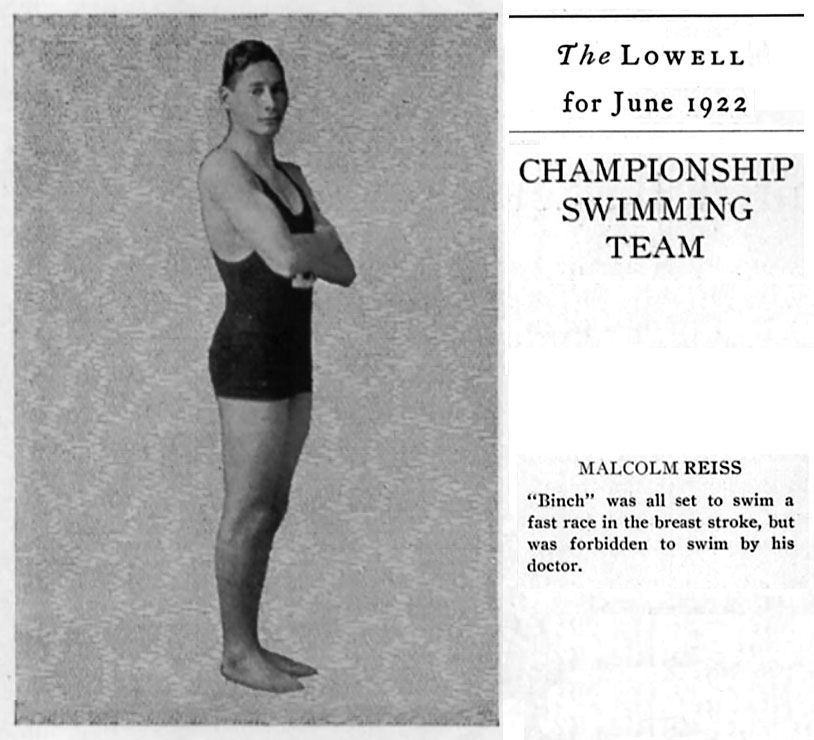
In December of 1922, at the age of seventeen, he graduated from high school and afterwards attended Stanford University in Palo Alto, CA, where he majored in economics. While at Stanford he wrote several humorous stories for a student newspaper.
During his summer vacations he worked for the South Pacific Rail Road as a land surveyor, and traveled from Arizona to Oregon.
On February 11, 1926, at the age of twenty-one, Malcolm Reiss graduated with a degree in economics from Sanford University. Although his education and family life had prepared him for a career as a businessman, he wanted to become a writer of popular fiction.
In the summer of 1926 he lived with his parents at 3806 Clay Street in San Francisco, while he worked as a clerk at a department store affiliated with his family’s wholesale woolen business.
On September 6, 1926 at the age of twenty-one, Malcolm Reiss sailed from San Francisco to Havana Cuba, on the Steam Ship Mongolia.
In 1927 he worked at the Reiss Brother’s Woolen Goods Company, in San Francisco.
In 1928 a California newspaper reported his attendance at a friend’s wedding in San Mateo,CA.
In September of 1928 Malcolm Reiss moved to New York City to seek his fortune as an author of adventurous short stories. He lived at 145 East 74th Street on the swanky Upper East Side.
He enrolled in Mabel Robinson’s course in Juvenile Writing at Columbia University. He later claimed, “It was one of the wisest things I had ever done, for the instruction, the criticism, and the work habits proved invaluable.” While studying at the school he met another brilliant literary student, Lucia Blanca Alzamora. She was born October 21, 1903 in Lima, Peru. Her father, Isaac Alzamora, was born in 1851 in Peru of Jewish ancestry. Her mother, Manuela Alzamora, was born in Chile in 1865 of Spanish ancestry. Her parents had six children. The family moved to America in 1910 and lived in New York City at 246 West End Avenue. Lucia Alzamora had graduated from Barnard College in 1924. She was a writer of short stories, and was an Assistant Editor at Alfred A. Knopf Publishing Company, located at 501 Madison Avenue on 52nd Street.
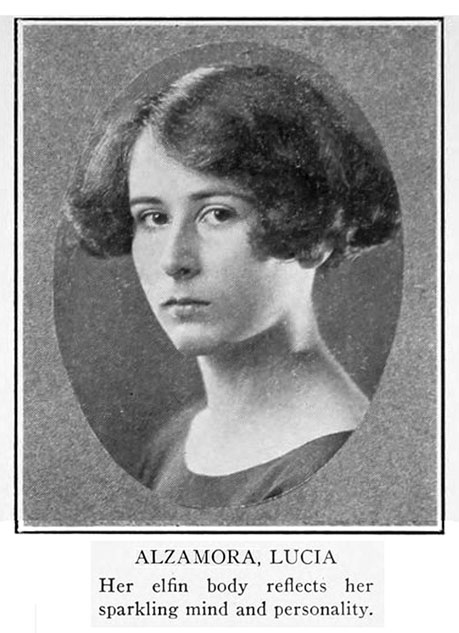
In 1929 Malcolm Reiss began to work in the advertising department at Alfred A. Knopf.
On June 14, 1930 Malcolm Reiss married Lucia Blanca Alzamora. They lived together in his apartment at 145 East 74th Street.
Malcolm Reiss wrote short stories, which were eventually published in Collier’s, Boy’s Life, True Western Adventures, 10-Story Western, Star Western, Dime Western, and The Saturday Evening Post. He signed most of his work, but he occasionally used the pen-name William “Buck” Ryall.
Lucia Reiss wrote stories that were eventually published in Cosmopolitan, Redbook, Collier’s, Argosy, Ladies Home Journal, The Delineator, and The Saturday Evening Post. She later became an editor at Reader’s Digest Magazine, and wrote for The New York Times Book Review.
In 1931 Malcolm Reiss sold two short stories, to Fiction House, “Land of Lost Men” for the September issue of North-West Stories, and “The Cover-Up Shot” for the December issue of Frontier Stories. The Editor was Jack Byrne.
Fiction House was located at 461 Eighth Avenue and 34th Street in Midtown Manhattan. It was founded in 1921 by John Glenister and Jack Kelly. In 1931 the company’s General Manager was Glenister’s Son-In-Law, Thurman T. Scott, a successful salesman of steam engines and oil burners with a high school education.
On April 4, 1932 the company’s co-founder, Jack Kelly, died. Five months later, Fiction House suddenly stopped production. Although newspaper accounts from this unique hiatus quoted Thurman T. Scott as attributing the stoppage to the higher costs of authors and loss of sales to cheaper competitors, the actual reason was a lawsuit by Jack Kelly’s widow, Laura A. Kelly, who preferred to withdraw her inherited fortune from partnership with Fiction House. Her attorney demanded the liquidation of the company in order to pay her one half of its market value. While the court decided the matter, Fiction House was ordered to stop spending her money on production. After a lengthy appeal the court permitted the company to resume printing in order to retain their titles and mailing privileges, but they were only permitted to produce magazines on a quarterly schedule, in order to keep costs to a minimum until a settlement was finally reached two years later.
During this 1933 stoppage Malcolm and Lucia Reiss sailed from New York City to visit Europe. They traveled to his wife’s ancestral home in Spain, and then visited his own ancestral town in France. They also visited North Africa, Austria, and Germany.
In September of 1933 Malcolm Reiss returned to NYC and his job as an editor at Fiction House Publications, while the company underwent a drastic financial reorganization. Their first magazines to resume publication were dated January 1934.
In 1936 Jack Byrne left Fiction House and began to work at Munsey, where he managed the pulp magazine, Argosy. At that point Malcolm Reiss replaced Jack Byrne as the chief editor at Fiction House. Malcolm Reiss eventually edited Aces, Action Stories, All-American Football, Baseball Stories, Basketball Stories, Bull’s Eye Detective, Civil War Stories, Detective Book, Fight Stories, Football Action, Lariat Story, Jungle Stories, North-West Romances, Two Complete Detective Books, and Wings.
In 1938 Fiction House started a line of comic books, which soon grew to include Jumbo Comics, Fight Comics, Jungle Comics, Planet Comics, Rangers Comics, and Wings Comics.
In 1939 Malcolm and Lucia Reiss had a son, Malcolm Alzamora Reiss, and a few years later their second child was born, William Blum Reiss.
In 1940 Thurman T. Scott suffered a collapse. His doctors prescribed semi-retirement, so he and his wife left NYC and moved to their vacation home, a plantation in Thomasville, Georgia. Jack Byrne returned to Fiction House to join Malcolm Reiss as co-publisher.
In 1940 the Reiss family lived at 466 East 66th Street on the chic Upper East Side of Manhattan.
In 1942 they were listed at 162 East 80th Street.
On December 1, 1943, during World War II, Malcolm Reiss joined the New York National Guard, and served in Company C, 17th Regiment. On October 6, 1944 he was sent as an officer in a Psychological Warfare Unit to support Generalissimo Chang Kai-Shek in Kunming, China, which was at the end of the Burma Road supply route of the Chinese Republican Army.
After the war, on September 24, 1945, Malcolm Reiss shipped out from Karachi, India, on his return voyage aboard the troop ship U.S.S. General J. H. McRae. He was honorably discharged and returned to his publishing career in NYC.
By 1945 Fiction House had moved to 670 Fifth Avenue on 53rd Street. That year they produced the 16th Illustrated Football Annual, which was edited by Jack Byrne and Malcolm Reiss.
By 1950 readership continued to decline as television became an increasingly popular source of fantasy entertainment.
In 1950 Fiction House moved to 130 West 42nd Street near Eighth Avenue.
By 1953 Fiction House ceased to publish pulp magazines, which had grown unprofitable. The following year Fiction House ceased to publish comic books, which had also grown unprofitable.
In 1954 Malcolm Reiss and his family moved to Wilton, Connecticut, where they bought a home at 113 Drum Hill Road.
In 1954 Jack Byrne and Malcolm Reiss patented a 3-D comic book, The First Christmas.
On October 21, 1954 The Tyrone Daily Herald favorably reviewed the novel “China Boat Boy” by Malcolm Reiss from Lippincott Publishing Company.

In 1957 the NYC Business Directory listed Malcolm Reiss as a “publisher” with offices at 342 Madison Avenue.
In 1960 Malcolm Reiss opened the Reiss Literary Agency.
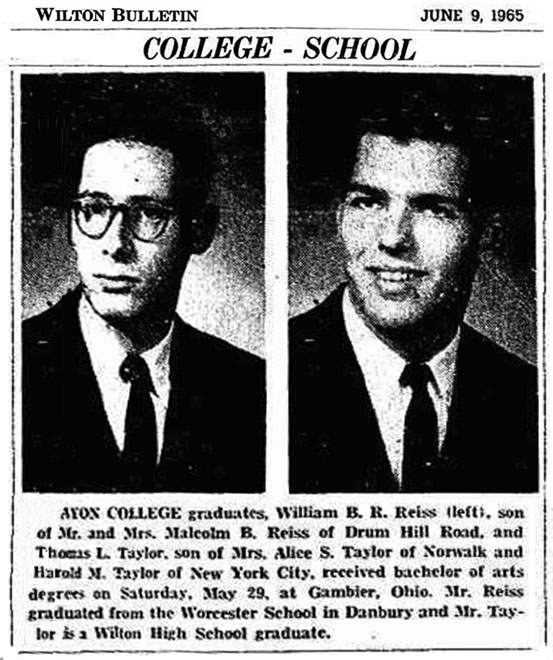
In 1966 Malcolm Reiss became a Vice President at the Paul Reynolds Literary Agency.
In 1968 Malcolm Reiss sold some valuable family property at 164 Townsend Street in San Francisco to the West Coast Ship Chandlers Company.
In 1970 Lucia Reiss retired as Editor of Reader’s Digest Magazine.
Malcolm Reiss died at the age of seventy in the hospital of Norwalk, CT, on December 16, 1975.
His wife, Lucia Blanca Alzamora Reiss, died at the age of ninety-one at home in Wilton, CT, on January 28, 1995.
Literature Review
Chapter 1.1
Planet Stories
In the early 1940s, science fiction pulp magazines began to place a renewed importance on scientific extrapolation and social commentary in their stories. Many readers desired a return to the fantastic worlds and the interplanetary adventures that, in large part, had defined scientific romances of the previous decades, however, and this desire was answered, in the winter of 1939, with the premiere issue of Planet Stories.
Planet Stories was published by Fiction House, a company that, with titles that included Action Stories (1921) and Wings (1928), already held some ground in the pulp arena, under the guidance of publisher Thurman T. Scott. Fiction House went dormant for several years at the height of the Great Depression, but it resumed activity in 1934. Following this rebound, the company sought not only to reestablish itself in the pulp market, but also to stake out a claim in the burgeoning comic book field. Thus, Planet Stories was launched alongside Planet Comics, just as Fiction House pulps Jungle Stories (1938) and Fight Stories (1928) later spawned Jungle Comics and Fight Comics, respectively.
Planet Stories‘ first (and throughout most of the title’s run, senior) editor was Malcolm Reiss. With the help of assistant Julius Schwartz (best-known for his own sf writings, and his role in the birth of comics’ Silver Age at DC Comics), Reiss presented stories that, while science fiction in genre, played to an audience mostly interested in interplanetary escapism and exotic alien worlds, rather than any die-hard dedication to scientific prophecy. This is not to say that Planet Stories did not offer “real sf” to its readers. Many great authors of the genre – past, present and future – contributed to its pages.
Early on, Planet Stories‘ illustrations were provided by sf art legend Frank R. Paul, who had defined much of the genre’s appearance and feel during the 1920s in the pages of the first sf magazine, Hugo Gernsback’s Amazing Stories; shortly after its debut, artists such as Hannes Bok, Kelly Freas, and Alexander Leydenfrost helped Planet Stories forge an identity all its own.
Literary works by Ray Cummings, Clifford Simak, Theodore Sturgeon, and other veterans also appeared, as did early works by Leigh Brackett, Isaac Asimov, Ray Bradbury and Poul Anderson. Throughout the 1940s and early 50s, seventeen stories by Brackett appeared first in Planet, along with two of the components that would later be collected in Bradbury’s The Martian Chronicles; Philip K. Dick’s first professionally-published work appeared in Planet Stories in the summer of 1952. The magazine’s letter column, titled “The Vizigraph,” provided an international forum for discussion, criticism, and correspondence nearly as important to the formation of early sf fandom as any of those in the earlier Gernsback titles.
Planet Stories was published on a quarterly basis for most of its existence, with a brief bi-monthly experiment in 1943 (which was cut short by wartime paper shortages), and again from January of 1951 to May of 1954. Back to its original quarterly publication schedule, Planet Stories lasted longer than many other pulp titles, which by then had transformed into either men’s mags or “slick magazines;” simply disappeared; or, in the case of sf titles such as Astounding Stories, had transitioned into smaller, digest-sized formats. In the summer of 1955, Planet Stories ended, with 71 issues to its name.
Planet Stories was an American pulp science fiction magazine, published by Fiction House between 1939 and 1955. It featured interplanetary adventures, both in space and on other planets, and was initially focused on a young readership. Malcolm Reiss was editor or editor-in-chief for all of its 71 issues. Planet Stories was launched at the same time as Planet Comics, the success of which probably helped to fund the early issues of Planet Stories. Planet did not pay well enough to regularly attract the leading science fiction writers of the day, but did manage to obtain work from well-known names on occasion, including Isaac Asimov and Clifford Simak. In 1952 Planet published Philip K. Dick’s first sale, and went on to print four more of his stories over the next three years.
The two writers most identified with Planet Stories are Leigh Brackett and Ray Bradbury, both of whom set many of their stories on a romanticized version of Mars that owed much to the depiction of Barsoom in the works of Edgar Rice Burroughs. Bradbury’s work for Planet included an early story in his Martian Chronicles sequence. Brackett’s best-known work for the magazine was a series of adventures featuring Eric John Stark, which began in the summer of 1949. Brackett and Bradbury collaborated on one story, “Lorelei of the Red Mist”, which appeared in 1946; it was generally well-received, although one letter to the magazine complained that the story’s treatment of sex, though mild by modern standards, was too explicit. The artwork also emphasized attractive women, with scantily clad damsels in distress or alien princesses on almost every cover.
Ray Bradbury in Planet Stories follows Ray’s first publications in Weird Tales. Where those stories would eventually lead to Dark Carnival (Arkham House, 1947), the tales of space from Planet Stories would find their way into Bradbury’s SF bestseller, The Martian Chronicles (Doubleday, 1950). Planet Stories offered Bradbury a place to work on his own brand of SF, poetic but still about aliens and strange worlds. (Readers weren’t always happy about it in the letter columns.) John W. Campbell’s Astounding Science-Fiction would never have published these kinds of tales.
1.2 Amazing Stories
Amazing Stories was an American science fiction magazine launched in April 1926 by Hugo Gernsback’s Experimenter Publishing that survived for almost eighty years. It was the first magazine devoted solely to science fiction
despite his ambitions, Gernsback struggled to bring science fiction into the realm of “literature.” Focusing more heavily on the science instead of the story-telling, he would be criticized for not holding high enough editorial standards and “ghettoizing” the genre (source: The Time Machines). Of course, this did not hinder the magazines popularity, and within its first year Gernsback had a circulation of over 100,000.
When the Great Depression struck, many pulps faltered or folded. Amazing was fortunate enough to be a recent acquisition of Macfadden Publishing, which managed to maintain some level of wealth as a source of escapist entertainment through the 1930s. The patronage of Macfadden kept the magazine afloat, but it still suffered both in quality and readership. By 1934, circulation had fallen to little more than 25,000. In 1935, Amazing changed its publishing schedule from monthly to bi-monthly.
After a decade under the lethargic editorship of Thomas O’Conor Sloane, Amazing picked up again in the 1940s with the help of Raymond A. Palmer. Palmer solicited the works of Edgar Rice Burroughs (whose work published in Amazing was actually largely that of his son, John Coleman) whose name boosted sales and saved the magazine. In 1944, Ray Bradbury published two stories with Amazing as he built a name for himself. Part of the publication’s popularity was due to the publication of the Shaver Mystery, a story written by a reader with whom Palmer had a public correspondence in the magazine. Richard S Shaver claimed to have seen visions of the supernatural, and Palmer latched onto him advertising the mystery in editions leading up to its publication and daring his readers to believe it. The story, “I Remember Lemuria,” tells of Atlan, a pre-biblical civilization and the first on Earth. The mystery was wildly popular and further escalated Amazing‘s circulation for the next few years, though Palmer was criticized for it in Harper’s and other magazines of its ilk.
Though the Shaver Mystery boosted sales, it did little for Amazing Stories’ reputation as a publisher of quality science fiction. In the 1950s, with Howard Browne at the helm, the magazine increased its pay for authors from 1 to 5 cents a word and solicited stories from some of the biggest authors in the genre, including Isaac Asimov and Clifford Simak. Browne intended to repackage Amazing as a slick magazine, but budget cuts from the Korean War kept this new edition from publication. It remained a pulp, but still published the new content which was enough to help change the minds of some who had dismissed the magazine.
By the end of 1950s, Amazing was stumbling yet again. This time, it was revived by editor Cele Goldsmith who brought Asimov back into the fold as well as publishing a new group of authors like J.G. Ballard and Philip K. Dick. Goldsmith also published Ursula K LeGuin and Roger Zelazny’s first professional stories in the 1960s.
After Goldsmith, Amazing was sold and languished for a few years before coming under the successful editorship of Ted White throughout the 1970s. However, due to troubles with the publisher, White resigned in 1979. After White’s departure, the magazine lasted until 2005, but it would never reach the same level of prominence achieved before 1980 again.
The first issue of Amazing Stories, Volume 1 No. 1 (pictured above) was published in April, 1926, by Hugo Gernsback. (A reprint edition is available on Amazon.) If you don’t happen to know, this is the fellow for whom the Hugo Award is named.
“Hugo Gernsback emigrated to the USA in 1904, designed the world’s first home radio set, and began a mail-order business to distribute the device. As part of the effort, he began the Telimco catalog. This was followed by a series of radio and electronics magazines: Modern Electrics, Electrical Experimenter (later changed to Science and Invention in 1920), and Radio News (1919).
The reader response to some science fiction stories published in Science and Invention was great, and in 1925 he announced a forthcoming magazine specializing in science fiction called Scientifiction. Response was poor, so Gernsback changed the name of the new magazine to Amazing Stories. Science fiction had been regularly published in Argosy and All-Story Weekly, but there had never been a magazine singularly devoted to the genre.
Amazing had a 69-year run before being declared “officially” dead in 1995 after TSR failed to find a buyer for the magazine. The magazine was revived yet again in 1998, this time with an emphasis on media-related fiction.”
1.3 The Shadow Legendary Pulp Super Hero
The Shadow, created by Walter Gibson in 1931, was a mysterious figure cloaked in black who fought mobsters, evil scientists, crazed old men and foreign invaders with two blazing automatic handguns and a chilling laugh.
The Shadow had been introduced to the public on July 31, 1930. The character was the mysterious narrator for THE DETECTIVE STORY HOUR, a CBS radio program sponsored by the Street & Smith pulp chain.
With customers inquiring for “that Shadow magazine” at newsstands, the publisher thought the time might be ripe for a revival of the single-character magazine.
In 1931, Walter Gibson had been a full-time professional writer for over ten years, supplying daily features to Philadelphia’s Ledger Syndicate and other newspaper syndicates. He had written the book HOUDINI’S ESCAPES for Harcourt, Brace, and Company, and was a regular contributor of “fictionized fact articles” for Macfadden’s TRUE STRANGE STORIES. He was also a ghostwriter for magicians Harry Blackstone, Harry Houdini, and Howard Thurston, penning articles and books for them under their names.
After the first two issues of THE SHADOW: A DETECTIVE MAGAZINE had flown off the stands, Gibson signed on to produce one story a month. About a year later, he was asked to double his output as THE SHADOW MAGAZINE was to appear twice each month.
Writing as Maxwell Grant, Gibson single-handedly produced the first 112 Shadow novels. Then to Gibson’s surprise, “Partners of Peril,” was published in the November 1, 1936 number of THE SHADOW MAGAZINE. It introduced a new writer to Walter Gibson and Shadow readers — Theodore A. Tinsley.
From 1936 – 1943, Theodore Tinsley wrote 27 of The Shadow’s adventures. Although modeled after Gibson’s formula, Tinsley’s Shadow tales are more hardboiled, violent, and sexual. This, despite pulp writer Frank Gruber’s description of the author:
n 1946, Walter Gibson left THE SHADOW due to a contract dispute. His replacement was Bruce Elliott — a writer and editor for magic journals who had been introduced to Street & Smith by Gibson.
The third Maxwell Grant had begun working on the publisher’s comic books in 1940. According to the late Robert Sampson, editor William de Grouchy liked Elliott’s work and had asked him to write some Nick Carter backup stories for THE SHADOW. “When the contract dispute with Gibson occurred, de Grouchy again turned to Elliott, this time for Shadow novels.”
Whereas Theodore Tinsley had modeled his Shadow novels after Gibson’s format, the Elliott Shadow was largely subsumed by Lamont Cranston.
Walter Gibson really did create The Shadow as pulp and radio fans think of him – his vision of The Shadow was both modern and arcane, a ruthless figure hiding behind a bewildering series of disguises and identities. He had no “powers” in the superhero sense, and only used the occult to bring fear to his adversaries. His crime-solving ability recalled that of Sherlock Holmes, but he had no John At the time no one knew what the Shadow looked like, or what his back story was, or anything at all about him — save his voice. In fact, the cover of the first issue didn’t even have the Shadow on it — Street and Smith used the only cover art they could find that had any kind of pronounced shadow. Gibson took it and created the first Shadow novel, “The Living Shadow” out of whole cloth (and set a substantial part of it in New York’s Chinatown).
The Shadow became a mysterious figure wrapped in black sable, dispensing justice through his network of operatives, only intervening at key events. Over the course of Gibson’s 283 novels published in the magazine, readers gradually learned more about the Shadow’s mythos.
In addition to writing a 60,000-75,000 novel a month (and initially the pace was two a month), he also continued to write novellas and short stories about other characters. He also maintained a column about codes, and — being a practicing professional magician — wrote a magic column and several books about magic as well. He also performed, wrote radio scripts, comic books, and newspaper comic strips, and devised new puzzles and magic tricks.