
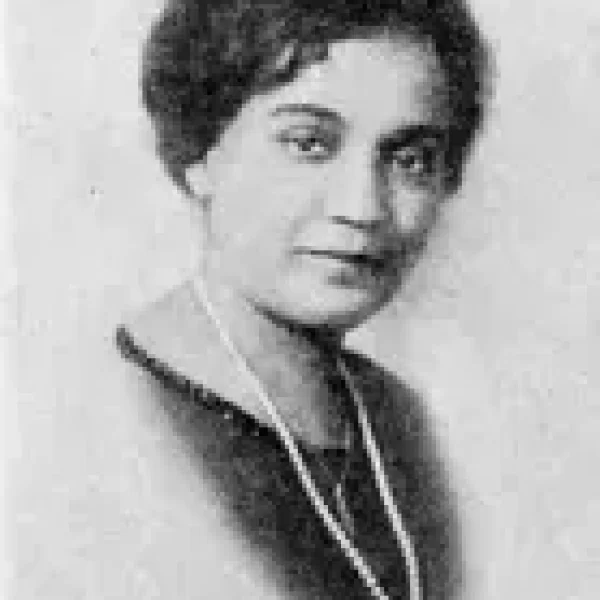
Jessie Redmon Fauset
4/27/1882 – 4/30/1961
Geographic Connection to Pennsylvania: Philadelphia, Philadelphia County
Born in Philadelphia, Jessie Redmon Fauset contributed greatly to the Harlem Renaissance in Washington, DC, as a writer and editor.
Abstract:
One the lesser-known figures of the Harlem Renaissance, Jessie Redmon Fauset was born in 1882. Early in life her family moved from New Jersey to Philadelphia. Though she wished to attend Bryn Mawr, she received scholarship money to attend Cornell University. Upon failing to gain employment as a teacher in the Philadelphia area, she taught in Washington until W.E.B. DuBois called her to work for the NAACP’s The Crisis Magazine. While there she published essays, poems, and stories of her own, as well as edited works of the major figures of the Harlem Renaissance. Her own works did not receive much attention at the time, but they are currently being revived academically, particularly her novel Plum Bun (1928). She died in Philadelphia in 1961.
Background of the Study:
Jessie Redmon Fauset was born April 27, 1882, in Camden, New Jersey. Her parents were Redmon Fauset, an African Methodist Episcopal minister, and Annie Seamon Fauset. Redmon Fauset married Bella Huff after the death of Annie Fauset and the couple moved their family to Philadelphia. In 1929, Jessie Fauset married Herbert Harris, an insurance broker, at the age of 47. The couple resided with Fauset’s sister, Helen Lanning, in Harlem, New York until Lanning’s death in 1936. Fauset and Harris were separated from 1931 to 1932. In the 1940s, they moved to New Jersey, where they lived until Harris died in 1958. The couple had no children.
Fauset graduated with honors from Philadelphia’s High School for Girls in 1900 as the only African American student. She applied to Bryn Mawr College and rather than accepting her as a student, the college helped Fauset obtain financial aid to attend Cornell University. Fauset studied classical languages at Cornell and was elected to the honor society, Phi Beta Kappa. After she graduated from Cornell in 1905, Fauset searched for a teaching job in Philadelphia, but was denied a position because of her race and sex. She eventually obtained a job at the Douglass High School in Baltimore, where she taught for one year. Fauset then moved to Washington, DC, to teach French at the M Street High School, where she remained for 14 years. In 1919, sociologist and political activist W.E.B. DuBois asked Fauset to move to New York City and accept a position as the literary editor of The Crisis Magazine. Fauset received a Masters of Arts Degree from the University of Pennsylvania in 1929 and a certificate from the Sorbonne in Paris, France.
Fauset is most noted for her work on The Crisis Magazine, the official publication of the National Association for the Advancement of Colored People (NAACP). As editor, Fauset published the works of Harlem Renaissance writers such as Countee Cullen, Langston Hughes, and George Schuyler. In addition to editing the magazine, Fauset also contributed some of her own essays, poetry, and short stories to the magazine. In 1920 and 1921, she spent time as the editor of the NAACP monthly children’s magazine, The Brownie’s Book. Much of the credit for her work was given to the magazine’s founder, W.E.B. DuBois. Fauset also published four novels during her career as a writer. The first novel, There is Confusion, was published in 1924 and was created as a response to what Fauset believed to be an inaccurate portrayal of black life in fiction. The second novel, Plum Bun, is the story of a woman trying to make people believe she is white, and the novel is Fauset’s most acclaimed piece of work. Her final two novels, The Chinaberry Tree and Comedy, American Style, followed in 1931 and 1933, respectively.
Content of the Problem
Jessie Fauset only received a small amount of recognition and honor during her life and career as a writer. Some believe her modesty and selflessness kept her from becoming a greater figure in literature. Although she did not receive awards for her work, she is now remembered for her success in writing, editing, translating, and teaching. Her work has also been included in various anthologies. On April 30, 1961, Jessie Redmon Fauset in died of heart disease in Philadelphia, Pennsylvania.
Significance of the Study
Plum Bun tells the story of Angela Murray – a young very light skinned African American woman who leaving her home in Philadelphia heads to New York where she intends to pass for white.
The novel starts with Angela in her mid-teens living happily with her family in a small house in Philadelphia. She has a younger sister Virginia (Jinny) – and parents; Mattie and Junius are simply devoted to one another. It is a happy, united family – though as she has grown up, Angela has begun to associate all the things she sees as worth having in life with being white. Like her mother Mattie, Angela has the pale skin inherited from her white ancestors – both Mattie and Angela are able to pass for white – sometimes deliberately – sometimes quite by accident. Virginia by contrast has a brown skin like her darker skinned father. Mattie sometimes chooses to ‘pass’ for convenience, and because she despises the stupid, prejudicial rules of the society in which they live. Mattie’s ability to ‘pass’ has quite an effect on her daughter Angela and unwittingly a seed is sown.
Again, Plum Bun tells the story of Angela Murray – a young very light skinned African American woman who leaving her home in Philadelphia heads to New York where she intends to pass for white.
The novel starts with Angela in her mid-teens living happily with her family in a small house in Philadelphia. She has a younger sister Virginia (Jinny) – and parents; Mattie and Junius are simply devoted to one another. It is a happy, united family – though as she has grown up, Angela has begun to associate all the things she sees as worth having in life with being white. Like her mother Mattie, Angela has the pale skin inherited from her white ancestors – both Mattie and Angela are able to pass for white – sometimes deliberately – sometimes quite by accident. Virginia by contrast has a brown skin like her darker skinned father. Mattie sometimes chooses to ‘pass’ for convenience, and because she despises the stupid, prejudicial rules of the society in which they live. Mattie’s ability to ‘pass’ has quite an effect on her daughter Angela and unwittingly a seed is sown.
“…it seemed to Angela that all the things which she most wanted were wrapped up with white people. All the good things were theirs. Not, some coldly reasoning instinct within was saying, because they were white. But because for the present they had power and the badge of that power was whiteness…”
Angela is mistaken for white by a new girl at school – and the reaction of her new friend when she discovers her error – is profound. As she and Jinny get older the race question is one often discussed and argued over in their group of friends.
“We’ve all of us got to make up our minds to the sacrifice of some thing. I mean something more than just the ordinary sacrifices in life, not so much for the sake of the next generation as for the sake of some principle, for the sake of some immaterial quality like pride or intense self-respect or even a saving complacency; a spiritual tonic which the race needs perhaps just as much as the body might need iron or whatever it does need to give the proper kind of resistance. There are some things which an individual might want, but which he’d just have to give up forever for the sake of the more important whole.”
As young women of colour, when Angela and Jinny leave school and go out into the world to earn their own living their options are few. Angela attends an arts academy after leaving school but for both sisters the best option open to them is to be teachers. They are only permitted to work in certain schools – and both sisters start out on this path. However, Angela does not really want to be a teacher – as an artist her ambitions lie elsewhere – and she resents how much of the world is closed to her – how few chances there are because of her racial identity.
Angela finds the society of Philadelphia just too narrow for her – and she longs to break away. One of the young men in Angela and Jinny’s circle of friends has rather fallen for her – but Angela is unable to return his feelings.
In her early twenties, Angela makes the decision to go to New York city – where she intends to continue her art studies – and live her life passing as white. Once in New York she enters the bohemian, artistic scene of Greenwich Village and begins a passionate relationship with Roger; a wealthy young man, who she quickly learns is horribly bigoted.
“Angela was visual minded. She saw the days of the week, the months of the year in little narrow divisions of space. She saw the past years of her life falling into separate, uneven compartments whose ensemble made up her existence. Whenever she looked back on this period from Christmas to Easter she saw a bluish haze beginning in a white mist and flaming into something red and terrible; and across the bluish haze stretched the name: Roger.”
Her romance puts her relationship with her sister in jeopardy as Jinny comes to New York to be near her sister – and Angela is forced to make some difficult decisions. Roger represents freedom and possibilities that have been so far barred to Angela, but at what cost? Over the course of the next year – Angela comes to learn a lot about herself, and about race in the United States in the late 1920s. Jessie Fauset shows us that the issue of ‘passing’ was a complex one, one that threw up all kinds of dilemma’s about family and identity.
Plum Bun is a fascinating and hugely readable novel, which despite its subtitle I do not think is entirely without moral. I found myself fully involved in the lives of these sisters, Angela is a flawed woman, but still so likeable – she acknowledges her errors and learns from them. It is a shame that this novel is not better known.
The novel’s relative obscurity
warrants a brief plot overview. Angela Murray, the
heroine, is born to a light-skinned mother and a dark
father, who live in cramped though happy circumstances for
the first quarter of the novel. After their deaths, Angela
abandons her loving, darker-skinned sister Virginia (Jinny)
and passes as white to gain economic mobility and social
status. While dabbling at art, Angela meets a white
millionaire who conveniently falls in love with her. He
tries to seduce her without marriage, while she tries to
elicit a marriage proposal without seduction. After
consummating and eventually ending the affair, Angela
embraces her art and her status as an African American, but
not before falling in love with another mulatto, Anthony
Cross. Complications ensue, but at novel’s end the couple
is reunited.