
Significance of the Study:
Sokar was a profoundly important and multifaceted deity in ancient Egyptian religion, serving as the god of the necropolis and the underworld. His significance is deeply intertwined with the funerary practices, beliefs about the afterlife, and the religious cosmology of the time. While his worship was centered in Memphis, his influence extended throughout Egypt, making him a crucial figure in the eternal journey of the soul. He was a protector of the deceased, a patron of artisans, and a key component in a powerful divine triad that embodied the very essence of existence. His legacy is one of transformation and eternal hope, reflecting the ancient Egyptian belief that death was merely a transition, not an end.
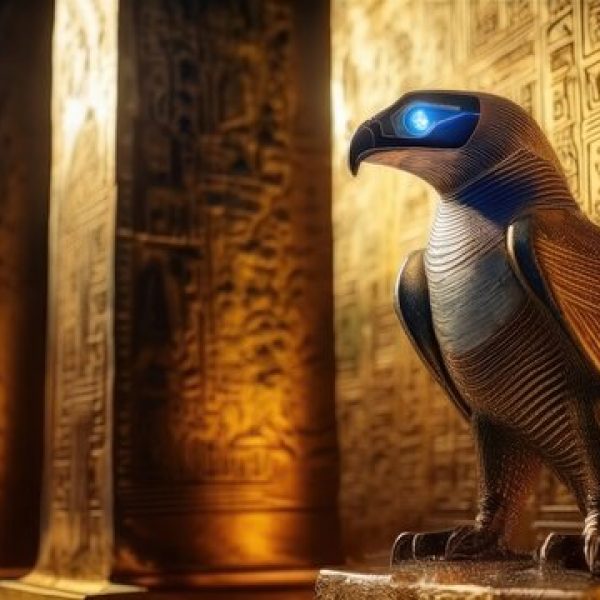
The origins of Sokar are ancient, with his worship dating back to the Old Kingdom period, flourishing particularly in the city of Memphis. As the principal deity of this major religious and administrative center, he was seen as a local god with universal importance. Sokar was most frequently depicted in two forms: as a mummified man with a falcon’s head and as a falcon perched on a mound of earth. The mummified form directly connected him to the funerary realm and his role as a guardian of the dead. It symbolized his mastery over the physical remains and his power to protect them from decay.
The falcon, a sacred animal in ancient Egypt, symbolized the divine and the soul’s ability to transcend the physical world and ascend to the heavens. This dual imagery highlighted his role as both a terrestrial and celestial deity, a guide who operated in both the tomb and the sky. His name, possibly derived from the phrase “sokar-n-re,” meaning “cleansing the mouth of Re,” alludes to his vital function in the “Opening of the Mouth” ceremony, a ritual designed to restore a person’s senses and vitality in the afterlife. Without this ritual, the spirit could not eat, drink, or move, making Sokar’s role in the afterlife a foundational one.
Sokar’s influence spanned many parts of ancient Egyptian life. His main role was a protector of the dead. He was the lord of the “hidden realm.” He guided souls through the dangerous underworld. The Book of the Dead and other funerary texts feature him prominently. He resided in the deepest parts of the underworld. He offered protection against chaotic forces. This protective role was very important. Even the sun god Ra relied on Sokar’s guidance. Ra transformed into Sokar’s form to navigate the most difficult regions. This showed Sokar’s authority over the chthonic realm.
Sokar’s most profound importance stemmed from his fusion with two other major deities: Ptah and Osiris. This syncretism resulted in the composite deity Ptah-Sokar-Osiris, a powerful symbol of the complete cycle of existence and the ancient Egyptian belief in eternal life.
Ptah, the creator god of Memphis, represented the beginning of all things and the divine act of creation.
Sokar represented the earthly realm, the underworld, and the process of death, serving as the bridge between life and the afterlife. He was the force that guided the body back to the earth.
Osiris, the god of rebirth and the afterlife, represented the ultimate goal of eternal life and resurrection. He was the ultimate destination of the soul, a place of peace and renewal.
People commonly depicted this powerful triad on funerary figures and sarcophagi. These
SOKAR (SOKER, SOKARIS) The ancient god of the cemeteries of Memphis, Sokar became the god of death as a transformative process. His qualities were often combined with those of the chief god of Memphis and the god of the dead to form the tripartite deity Ptah-Sokar-Osiris. The annual Festival of Sokar was one of the great events of the Egyptian ritual calendar
Sokar could be represented by a human or hawk head emerging from a mound or chest. He could also be shown as a shrouded hawk or as a hawk headed man or mummy. The silver hawk-headed anthropoid coffin of Sheshonq I (c. 945–924 BCE) was probably intended to transform the dead king into Sokar.
As a chthonic deity, Sokar had to be appeased when canals were dug, fields were plowed, or underground tombs were built. He was also a divine craftsman, responsible for making the silver bowls in which the feet of the dead were washed. At some point this aspect of Sokar seems to have been transferred to Ptah. Ptah and Sokar could be paired as creator deity and god of the dead as Ra and Osiris often were. As early as the Old Kingdom, Sokar was said to be the name of Osiris after he was murdered by his brother Seth.
In the Book of What Is in the Underworld, Sokar presides over a snake-infested desert region that must be crossed by the sun god and the royal dead. Sokar, Lord of the Mysterious Region, dwells in a cavern guarded by the two-headed Aker-sphinx. There he repeatedly overcomes a multiheaded chaos serpent. In later Underworld Books, it is the body of Sokar Osiris that lies in this mysterious cavern waiting for the reviving light of the sun. The spirits of the dead were thought to join in the Festival of Sokar, which seems to have celebrated the power to journey between the realms of the living and the dead. The image of the god was dragged through the necropolis in his henu barque, a special boat decorated with images of fish and antelopes. Sokar was accompanied by five daughters of Ra in the forms of geese. Statuettes of Ptah-Sokar-Osiris placed in tombs sometimes contain copies of the Book of the Dead.
Others conceal corn mummies, symbolic bodies of Sokar-Osiris, to help the tomb owner attain resurrection. Figures of Sokar were prepared as part of the month-long Khoiak Festival, the annual reenactment of the mysteries of Osiris. The instructions for making these figures were said to be based on a divine prototype. The goddess Shentayet of Busiris made a new body for Sokar out of clay, dates, sweet-smelling spices, and precious stones and metals. The mixture was shaped into an egg and then divided among fourteen vessels. This links Sokar to lunar myths of destruction and renewal
Handbook of Egyptian Mythology
Sokar is really one of the more complex Egyptian gods to understand. Over time, Sokar’s name196 has been shrouded in scholarly controversy. One theory,197 depicts his name as derived from and based on the term ‘sk-r’198 that was found in Coffin Texts and a Twelfth Dynasty papyrus.199 This term is used in the context of the Opening of the Mouth ceremony in which Sokar does play a part.200 Another theory is that the etymology of the god’s name comes from one of the Pyramid Texts where Osiris cried out for help to his wife and sister saying, ‘Sy-k-ri’, which translates to ‘hurry to me’.201 Sokar was an ancient falcon god from the area surrounding Memphis. He was originally associated with either the lord of both darkness and death or craftsmanship. Nevertheless,
through different texts and myths Sokar was also identified as the deification of the act of separating the Ba from the Ka, roughly the separation of soul from the body after death. As such, he also came to be a god of the Giza as well as the Memphis necropolis and an important funerary deity. In addition to the temple at Saqqara, Sokar also had other cult centers. At Giza he was the lord of the entrance to the Underworld. His sanctuary in the Memphite necropolis was called the Shetayet. From earliest times, he was also the patron of craftsmanship, particularly jewelers, armoires and other workers of metal. Sokar, at times was also associated with earth, reincarnation and as well as fertility god. The Pyramid Texts frequently mention the god in an afterlife context where the deceased king is said to be raised into the ‘henu-barque’ of Sokar which depending on the prevailing dynasty of ancient Egypt, the henu-barque sailed toward either dawn or dusk.205 The Pyramid Texts describe Sokar as a god active in the rebirth of the king and in the ceremonies of confirmation and transfer of royal power. Throughout time Sokar has also been related to two groups of deities, including the Memphite group which included Khnum and a solar group that consisted of Nefertem and the five divine daughters of Re.207 The Memphite Khnum is among the deities listed in the Sokar chapel and the hall of Sokar and Nefertem in the temple of Seti I at Abydos.
Though it is believed by some scholars that Sokar did not have any family except through the term ‘Redoudja,’ in Spell 941 of the Coffin Text (Figure 18) which translated to the ‘son of Sokar’.208 Other scholars believe that this is actually a misconception and mistranslation of an adjectival
phrase in the Coffin Text.209 Other scholars debate that his wife was either Sekhmet or Nephthys.210 Though Sokar had a number of nicknames, there is one that is of the utmost importance to mention, ‘he of Rosetau.’ The epithet given in the terms of Rosetau refers the entrance to the Underworld which directs to a place on the Giza Plateau.
Some of the other names he is also known by are the ‘lord of the mysterious region’ referring to the Underworld and the ‘great god with his two wings opened’ which refers to his place in the Fifth Hour.215 Through different texts, Sokar could be ichnographically depicted in various ways in addition to that of the falcon, which appears to have been his original form.216 The falcon seems ever present in his representations, evoking his divine ability to fly through the Underworld, on earth, and in the heavens. In the more symbolic forms, he is shown as a falcon’s head, which is sometimes set in a boat, surmounting an earthen funerary mound. In this regard, an image depicted in vignettes of the Amduat refers to him as ‘he who is upon his sand.’217 As a falcon headed man, Sokar is often depicted in a green mummified form and sometimes is adorned with a complicated conical crown that includes the sun disk horns and cobras, not unlike that of the Atef-crown. At times he is depicted wearing the White Crown and holds a scepter and a whip, also the regalia of Osiris