
Literature Review
There are two John Henrys, the actual man and the legend surrounding him. Defining the first is a matter of assembling facts. He was born a slave, worked as a laborer for the railroads after the Civil War, and died in his 30s, leaving behind a young pretty wife and a baby.
The story of John Henry, told mostly through ballads and work songs, traveled from coast to coast as the railroads drove west during the 19th Century. And in time, it has become timeless, spanning a century of generations with versions ranging from prisoners recorded at Mississippi’s Parchman Farm in the late 1940s to present-day folk heroes.
From what we know, John Henry was born a slave in the 1840s or 1850s in North Carolina or Virginia. He grew to stand 6 feet tall, 200 pounds – a giant in that day. He had an immense appetite, and an even greater capacity for work. He carried a beautiful baritone voice, and was a favorite banjo player to all who knew him.
One among a legion of blacks just freed from the war, John Henry went to work rebuilding the Southern states whose territory had been ravaged by the Civil War. The period became known as the Reconstruction, a reunion of the nation under one government after the Confederacy lost the war. The war conferred equal civil and political rights on blacks, sending thousands upon thousands of men into the workforce, mostly in deplorable conditions and for poor wages.
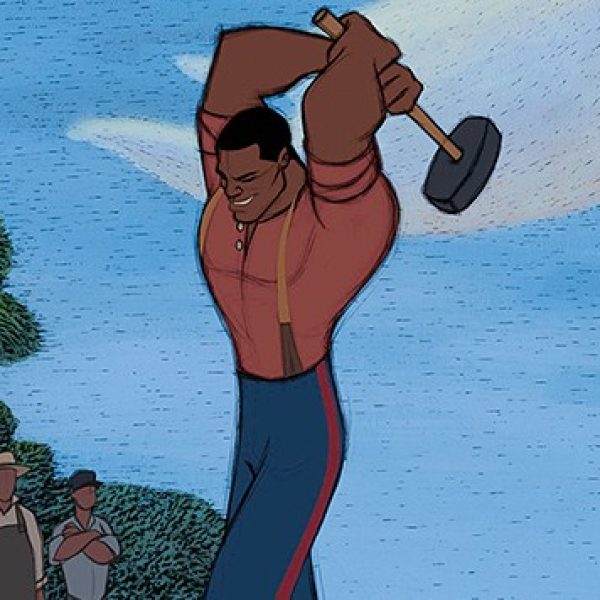
As far as anyone can determine, John Henry was hired as a steel-driver for the C&O Railroad, a wealthy company that was extending its line from the Chesapeake Bay to the Ohio Valley. Steel drivers, also known as a hammer man, would spend their workdays driving holes into rock by hitting thick steel drills or spikes. The hammer man always had a partner, known as a shaker or turner, who would crouch close to the hole and rotate the drill after each blow.
The C&O’s new line was moving along quickly, until Big Bend Mountain emerged to block its path. The mile-and-a-quarter-thick mountain was too vast to build around. So the men were told they had drive their drills through it, through its belly.
The story of John Henry, told mostly through ballads and work songs, traveled from coast to coast as the railroads drove west during the 19th Century. And in time, it has become timeless, spanning a century of generations with versions ranging from prisoners recorded at Mississippi’s Parchman Farm in the late 1940s to present-day folk heroes.
From what we know, John Henry was born a slave in the 1840s or 1850s in North Carolina or Virginia. He grew to stand 6 feet tall, 200 pounds – a giant in that day. He had an immense appetite, and an even greater capacity for work. He carried a beautiful baritone voice, and was a favorite banjo player to all who knew him.
One among a legion of blacks just freed from the war, John Henry went to work rebuilding the Southern states whose territory had been ravaged by the Civil War. The period became known as the Reconstruction, a reunion of the nation under one government after the Confederacy lost the war. The war conferred equal civil and political rights on blacks, sending thousands upon thousands of men into the workforce, mostly in deplorable conditions and for poor wages.
As far as anyone can determine, John Henry was hired as a steel-driver for the C&O Railroad, a wealthy company that was extending its line from the Chesapeake Bay to the Ohio Valley. Steel drivers, also known as a hammer man, would spend their workdays driving holes into rock by hitting thick steel drills or spikes. The hammer man always had a partner, known as a shaker or turner, who would crouch close to the hole and rotate the drill after each blow.
The C&O’s new line was moving along quickly, until Big Bend Mountain emerged to block its path. The mile-and-a-quarter-thick mountain was too vast to build around. So the men were told they had drive their drills through it, through its belly.
Still another reading interprets John Henry’s story as one rooted in sex and power. And indeed, some of the ballads depict John Henry as a man leashed to his sexual appetites, roaming the countryside to drive his steel, so to speak. In his 1933 book “John Henry A Folk-Lore Study,” historian Louis W. Chappell maintains that the ballad’s sexual symbolism is abundantly and unmistakably clear.
In the early 1870s, construction of the Chesapeake and Ohio Railway along the Greenbrier and New Rivers employed thousands of workers. Many of these men were African Americans who migrated to West Virginia in search of jobs. Jobs on the railroad were labor intensive and low paying, required long hours, and were at times dangerous.
Railroad workers primarily used shovels, wheelbarrows, mules, and black powder to move millions of tons of rock and dirt to prepare the railroad bed. Workers used axe and adz to cut and shape hundreds of trees into ties, bridge timbers, and lumber for railcars. They sweated in the hot summer sun and froze in the cold mountain winters as they worked to connect Tidewater Virginia with the Ohio River Valley.
As the C&O Railway stretched westward along the Greenbrier River, The Legend of John Henry was born at Big Bend Mountain near Talcott, West Virginia. The Legend of John Henry is just that, a “legend,” and through the legend, John Henry became a symbol. He symbolized the many African Americans whose sweat and hard work built and maintained the rails across West Virginia. He was a symbol for the black workers who gave their lives in these dangerous occupations. The legend, as told through ballads and work songs, has kept the story of John Henry and the black railroad workers alive.
In February of 1870, workers began drilling the Great Bend Tunnel where the Greenbrier River makes a seven-mile meander around Big Bend Mountain. Over 800 men, many of them African American, cut a 6,450 foot-long tunnel through the mountain. The workers cut through layers of red shale, which tended to disintegrate when exposed to air, making the tunnel a dangerous place to work. Rock falls were common and death was always a possibility. At nearly a mile and one quarter long, the Great Bend Tunnel is the longest on the C&O Railway.
The process of building a tunnel in the 1870s was slow and difficult work. Holes were drilled into the layers of rock using a hand drill and hammer. Holes were then filled with powder and blasted in order to make the rock small enough to remove from the tunnel. The drill was held by a “shaker” who turned it slightly after each blow and gave it a shake to flip the rock dust out of the hole. The “steel driver” swung the hammer as hard and as often as he could, pounding the drill into the rock.
As the story goes, John Henry was hired as a steel driver for the railroad. Later, the railroad company brought in a steam drill to speed up work on the tunnel. It was said that the steam drill could drill faster than any man. The challenge was on, “man against machine.” John Henry was known as the strongest, the fastest, and the most powerful man working on the railroad. He went up against the steam drill to prove that the black worker could drill a hole through the rock farther and faster than the drill could. Using two 10-pound hammers, one in each hand, he pounded the drill so fast and so hard that he drilled a 14-foot hole into the rock. The legend says that the drill was only able to drill nine feet. John Henry beat the steam drill and later died of exhaustion.
The Great Bend Tunnel was completed on September 12, 1872, and remained in service until 1974. The tunnel and the man have been cemented into the annals of time through The Ballad of John Henry. The song tells of a boy born with a “hammer in his hand.” It tells of a man who worked as a steel driver during the construction of the Great Bend Tunnel. It tells us that this man took a hammer in each hand to face down a steam-powered drilling machine. John Henry promised, “If I can’t beat this steam drill down, I’ll die with this hammer in my hand!” At the Great Bend Tunnel, John Henry became one of the world’s great folk heroes.