
Significance of Study:
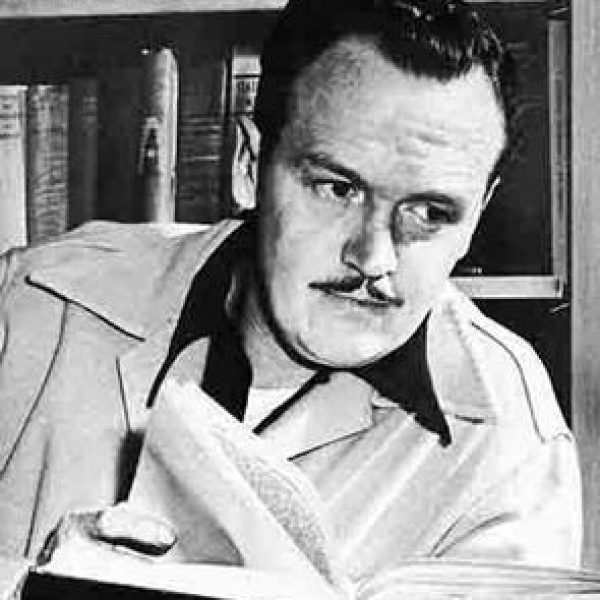
Alexander Gillespie Raymond Jr was born in 1909 to Beatrice and Alexander Raymond in New Rochelle, NY. Alex’s father was a civil engineer, who supported his son’s artistic interests. Sadly, the elder Raymond died when his son was 12, and Alex Jr. decided against going into art as a career. Instead, Raymond went to Iona Preparatory School on an athletic scholarship and pursued a career in finance. He briefly worked in a brokerage office on Wall Street, but the financial crash of 1929 ended that career path. Returning to his earlier ambitions, Raymond enrolled in the Grand Central School of Art in New York City, a storied institution that would count artists such as Normal Rockwell, Charles Addams, and Bob Kane among its alumni.
In 1930, Raymond began to work with cartoonist Russ Westover, assisting him on the comic strip Tillie the Toiler. Through Westover, Raymond was introduced to King Features Syndicate, one of the largest comic syndication companies to this day. Raymond worked as a staff artist for King Features, assisting on such strips as Tim Tyler’s Luck and Blondie.
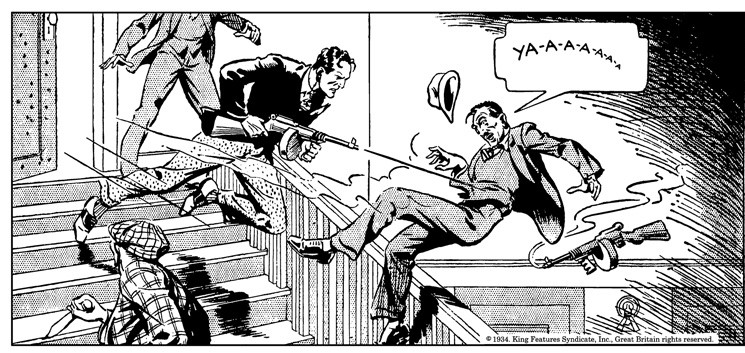
Raymond got his big break in 1933 with the comic strip Secret Agent X-9. This comic told the adventures of X-9, a nameless agent for a nameless government agency. The strip was created and written by legendary crime author Dashiell Hammett, who by this time had already written the Maltese Falcon and would soon go on to write The Thin Man. King Features assigned Raymond to do art for the strip, and the acclaim he got for X-9 would quickly set him up for the next step in his career.
In 1934, Raymond and ghostwriter Don Moore were assigned two more strips by King Features. These comics would be featured in the Sunday color comics page. Comic pages were bigger in the 30s, with much more space given to individual panels and strips than they are now. Certain large comics would run smaller strips (called “toppers”) above the main strip—two comics from the same artists in one space. Jungle Jim was one such topper. This adventure comic from Raymond and Moore told stories of explorer Jim Bradley and his adventures in the jungles of Asia. Jungle Jim ran above the comic that Raymond would become most famous for—Flash Gordon.
King Features wanted to create a comic to compete with John F. Dille’s popular Buck Rogers comic. King originally approached Edgar Rice Burroughs to discuss adapting his John Carter of Mars stories into comic form. While Burroughs was interested, he and the syndicate couldn’t come to an agreement. King Features instead tasked Raymond and Moore with creating an original science-fiction hero.

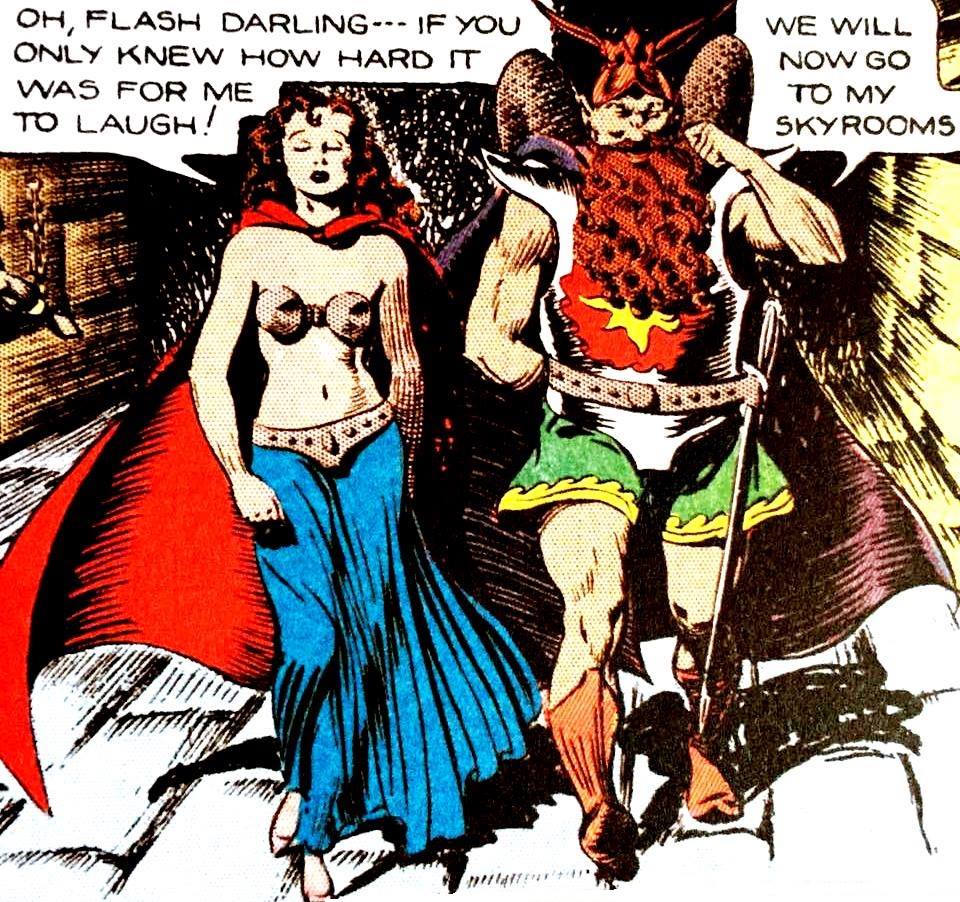
Flash Gordon featured the eponymous athletic hero Flash, his girlfriend Dale, the mysterious Dr. Zarkov and their adventures on the exotic planet Mongo ruled by the evil Emperor Ming. Moore’s sharp, exciting writing combined with Raymond’s lush, detailed illustrations would launch the strip to the heights of popularity, quickly outpacing their well-established rivals.
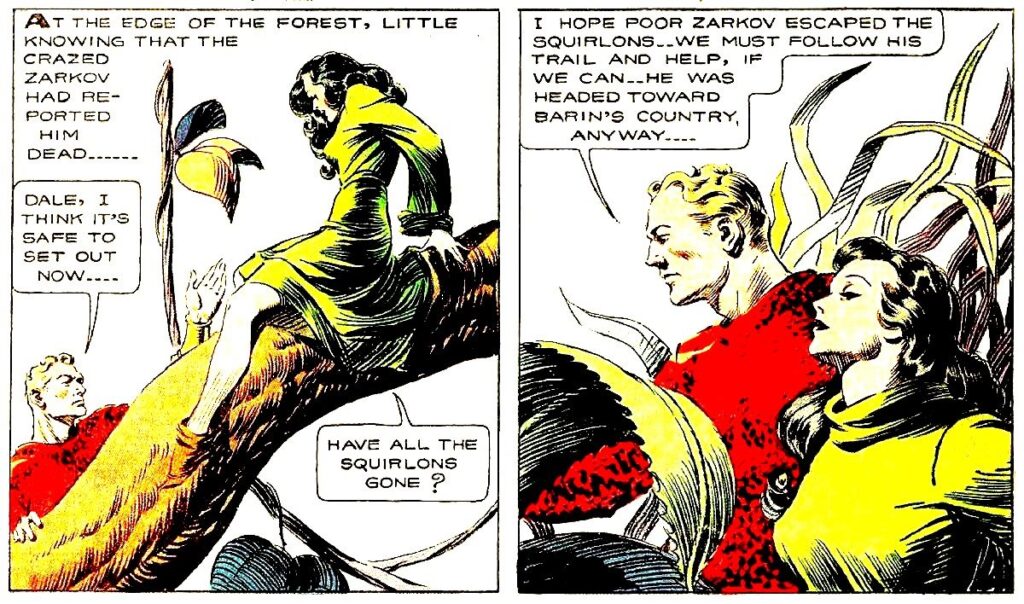
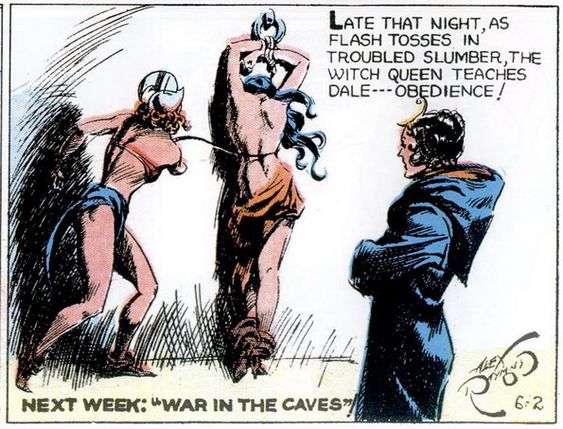
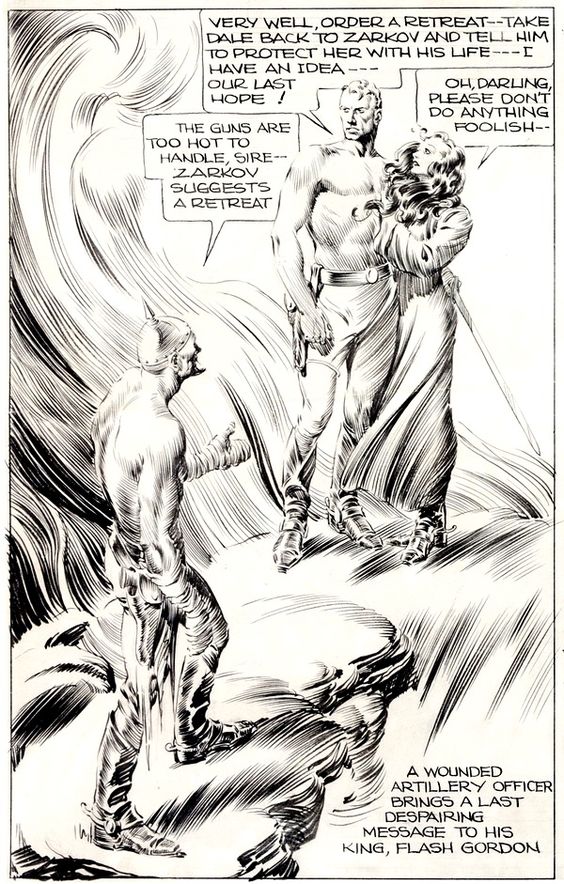
Raymond worked on Flash Gordon for the next 10 years. Over that time his technique and composition evolved. The panels grew larger, and while that meant there were fewer panels per strip, the larger area allowed Raymond to create more detailed and dynamic scenes. Raymond also began to forgo the use of word balloons, instead presenting dialog and narrative as text at the bottom of the panel. This allowed him to preserve his cinematic composition and sensual backgrounds without getting cluttered by comic ephemera. (This technique was also used in contemporary Hal Foster’s Prince Valiant strip).

Raymond left the comics industry in 1944 to join the U.S. Marines and fight in World War II. He was commissioned as a captain, and worked in public relations, creating patriotic recruitment posters and related art. He saw intense combat in 1945 serving aboard the USS Gilbert Islands in the Pacific theater. He was finally able to return to comics in 1946.
Raymond was not able to return to Flash Gordon. During his absence, the strip was continued by other artists, and King Features were unw
willing to remove them from the comic.
Significance of Study:
Alexander Gillespie Raymond Jr was born in 1909 to Beatrice and Alexander Raymond in New Rochelle, NY. Alex’s father was a civil engineer, who supported his son’s artistic interests. Sadly, the elder Raymond died when his son was 12, and Alex Jr. decided against going into art as a career. Instead, Raymond went to Iona Preparatory School on an athletic scholarship and pursued a career in finance. He briefly worked in a brokerage office on Wall Street, but the financial crash of 1929 ended that career path. Returning to his earlier ambitions, Raymond enrolled in the Grand Central School of Art in New York City, a storied institution that would count artists such as Normal Rockwell, Charles Addams, and Bob Kane among its alumni.
In 1930, Raymond began to work with cartoonist Russ Westover, assisting him on the comic strip Tillie the Toiler. Through Westover, Raymond was introduced to King Features Syndicate, one of the largest comic syndication companies to this day. Raymond worked as a staff artist for King Features, assisting on such strips as Tim Tyler’s Luck and Blondie.
Raymond got his big break in 1933 with the comic strip Secret Agent X-9. This comic told the adventures of X-9, a nameless agent for a nameless government agency. The strip was created and written by legendary crime author Dashiell Hammett, who by this time had already written the Maltese Falcon and would soon go on to write The Thin Man. King Features assigned Raymond to do art for the strip, and the acclaim he got for X-9 would quickly set him up for the next step in his career.
In 1934, Raymond and ghostwriter Don Moore were assigned two more strips by King Features. These comics would be featured in the Sunday color comics page. Comic pages were bigger in the 30s, with much more space given to individual panels and strips than they are now. Certain large comics would run smaller strips (called “toppers”) above the main strip—two comics from the same artists in one space. Jungle Jim was one such topper. This adventure comic from Raymond and Moore told stories of explorer Jim Bradley and his adventures in the jungles of Asia. Jungle Jim ran above the comic that Raymond would become most famous for—Flash Gordon.
King Features wanted to create a comic to compete with John F. Dille’s popular Buck Rogers comic. King originally approached Edgar Rice Burroughs to discuss adapting his John Carter of Mars stories into comic form. While Burroughs was interested, he and the syndicate couldn’t come to an agreement. King Features instead tasked Raymond and Moore with creating an original science-fiction hero.
Flash Gordon featured the eponymous athletic hero Flash, his girlfriend Dale, the mysterious Dr. Zarkov and their adventures on the exotic planet Mongo ruled by the evil Emperor Ming. Moore’s sharp, exciting writing combined with Raymond’s lush, detailed illustrations would launch the strip to the heights of popularity, quickly outpacing their well-established rivals.
Raymond worked on Flash Gordon for the next 10 years. Over that time his technique and composition evolved. The panels grew larger, and while that meant there were fewer panels per strip, the larger area allowed Raymond to create more detailed and dynamic scenes. Raymond also began to forgo the use of word balloons, instead presenting dialog and narrative as text at the bottom of the panel. This allowed him to preserve his cinematic composition and sensual backgrounds without getting cluttered by comic ephemera. (This technique was also used in contemporary Hal Foster’s Prince Valiant strip).
Raymond left the comics industry in 1944 to join the U.S. Marines and fight in World War II. He was commissioned as a captain, and worked in public relations, creating patriotic recruitment posters and related art. He saw intense combat in 1945 serving aboard the USS Gilbert Islands in the Pacific theater. He was finally able to return to comics in 1946.
Raymond was not able to return to Flash Gordon. During his absence, the strip was continued by other artists, and King Features were unw
willing to remove them from the comic.
Early life and career
Alexander Gillespie Raymond was born in 1909 in New Rochelle, New York, into a family of Irish-American descent. His father – an engineer working in the Woolworth Building – strongly supported his son’s artistic talents. Although Raymond showed an early interest in drawing, he held several jobs to support his family after his father passed away in 1922. By 1928, the youngster had dropped out of high school and became an order clerk with a brokerage firm in Wall Street. In the evenings, Raymond took a course from the Grand Central School of Art. The 1929 Wall Street Crash and the ensuing economic crisis in the USA cut Raymond’s career as a stockbroker short. For a while, he earned a living as a mortgage salesman, but eventually chose to pursue his artistic ambitions.
Of all his 1934 creations, ‘Flash Gordon’ became the most iconic. Debuting as a Sunday page on 7 January 1934, it evolved into one of the most iconic space operas of all time, running in newspapers until 2003. It also inspired a great many movie adaptations, TV and radio serials, comic books and merchandising lines. Raymond’s Jules Verne-type space opera headed for thrills right away. Starting with the first panel, humanity is threatened by a strange new planet approaching Earth. A flaming meteor, torn loose from the comet, hits a transcontinental plane with “Yale graduate and world-renowned polo player” Flash Gordon and Dale Arden, a female passenger, on board. Instantly portrayed as the true hero, Gordon parachutes himself and Dale to safety. On the ground however, they are captured by the desperate scientist Dr. Hans Zarkov, who takes the two innocent bystanders with him on a suicide mission: crashing his rocket into the approaching comet. And all this was only the first Sunday page! Gordon overpowers the mad scientist, but can’t prevent the rocket from crash-landing on the mysterious planet Mongo, ruled by Ming the Merciless (the name says it all). It is the beginning of an epic saga filled with strange creatures, intriguing landscapes, futuristic cities and machinery and highly imaginative science fiction.
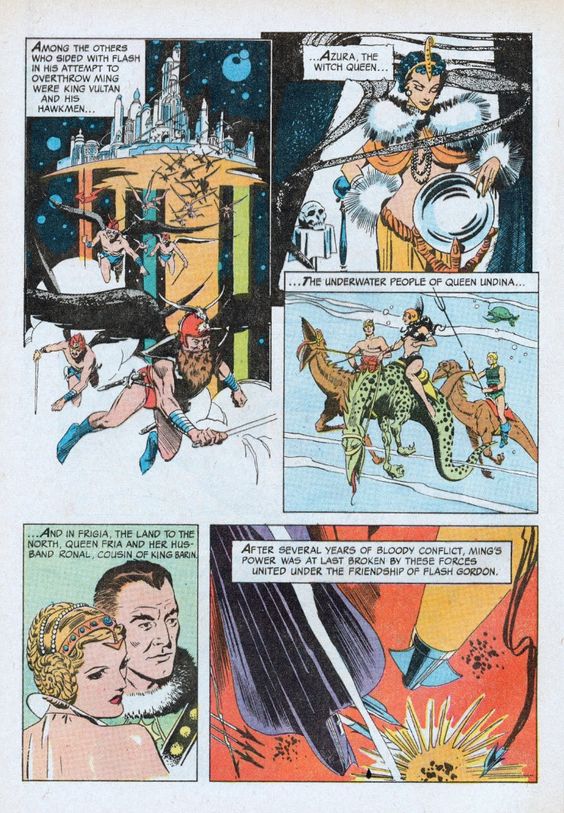
In most of the early stories, Flash Gordon is a heroic resistance leader, fighting against the ruthless Ming. Allies joining him in his battle are noble leaders like Prince Barin – ruler of the forest kingdom Arboria and the rightful heir to the throne of Mongo – as well as Prince Thun of the Lion Men and Prince Vultan of the Hawkmen. Ming’s daughter Princess Aura initially takes after her father, but she is reformed by her love for Flash, although her affections later turn to Prince Barin. In a July 1941 storyline, Flash, Dale and Zarkov leave the planet Mongo and return to Earth, motivated by news about an upcoming world war, initiated by the Fascist Red Sword organization. Obviously inspired by real-life World War II events, Flash manages to end this fictional war far sooner. In January 1942 – only one month after the Pearl Harbor attack – the Red Sword organization is overthrown.
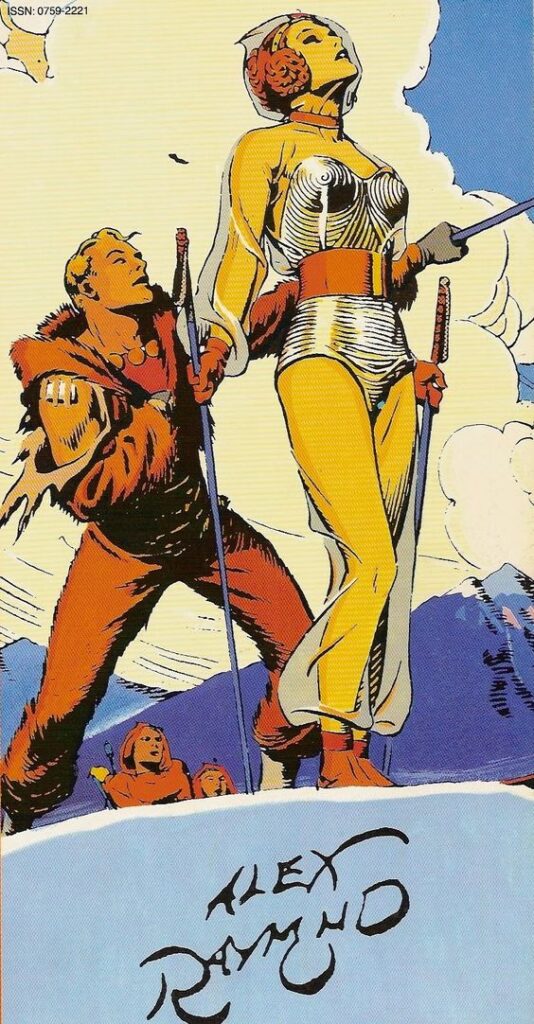
Alex Raymond created his plots in a steady collaboration with a ghostwriter, pulp novelist Don Moore. Raymond and Moore invented the most extraordinary worlds and creatures, brought to life with Raymond’s skillful brushwork. Taking inspiration from leading magazine illustrators like Matt Clark, Franklin Booth and John LaGatta, Alex Raymond brought character into his settings through his strong sense of realism and unique use of perspective. From the lush landscapes of Mongo and masterful renderings of sensual women to the egocentric splendor of Ming’s environment – Raymond was one of the first artists who made science fiction “believable”. As Mark Thompson wrote in his foreword for Checker’s first ‘Flash Gordon’ collection (2005), Raymond “brought the worldwide public into the visual age of science fiction”.
Flash Gordon – success and media adaptations
By the late 1930s, ‘Flash Gordon’ was read by 50 million people worldwide. It ran in 130 newspapers and was translated into eight foreign languages. The strip also gained popularity in Europe, where it appeared as ‘Guy L’Éclair’ (France), ‘Speed Gordon’ (Germany), ‘Jens Lyn’ (Denmark), ‘Lyn Gordon’ (Norway), ‘Blixt Gordon’ (Sweden) and ‘Stormer Gordon’ (The Netherlands/Flanders). Other countries kept the original title. The weekly installments of the space hero were faithfully adapted into a weekly radio serial called ‘The Amazing Interplanetary Adventures of Flash Gordon’, starring Gale Gordon as Flash. The radio versions of Flash and Dale however eventually returned to Earth and their adventures ended on 26 October 1935. A weekday radio serial called ‘The Further Interplanetary Adventures of Flash Gordon’ was launched two days later, featuring independent storylines different from the comic strip. A weekly time slot was filled by a ‘Jungle Jim’ radio serial starring Matt Crowley and later Gerald Mohr.
On January 7, 1934, man rst “slipped the surly bonds of earth,” and rocketed to the stars. What, you don’t remember it that way? at was the date Flash Gordon rst appeared in the com ics section of newspapers across the country. Written by Don Moore and illustrated by Alex Raymond, and intended to compete with the incred ibly popular Buck Rogers strip that debuted in 1930, the initial story told the tale of world-famous polo star Flash Gordon, who parachuted to earth when a meteor hit his plane. Fortunately, he managed to grab the beautiful Dale Arden on his way out of the aircra and, even more fortunately, they managed to land on the property of Dr. Hans Zarkov, who was building a rocket ship in his back yard in order to save the world from an impending collision with the Planet Mongo. Blasting o to save the day, Flash man aged to earn the enmity of Mongo’s emperor, the aptly named Ming the Merciless, gain the love of Ming’s daughter, the beautiful Aura, and become the hero of Mongo. Not bad for a day’s work. Beautifully rendered by artist Alex Raymond, the strip was an instant hit, soon eclipsing Buck Rogers in terms of both popularity and inuence due, to a great extent, to Raymond’s lush artwork that was light-years ahead of anything else being published at the time. If imitation is the sincerest form of attery, then Raymond must have been one of the most attered men in the history of comics. His detailed, highly-realistic style is studied and even copied to this day by students of visual arts. Flash was more than just a newspaper strip, however
Below is a Reference link :