

Literature Review
Tyroc, the Legion of Super-Heroes’ first black member, is someone who tends to invoke extreme reactions. First introduced in Superboy and the Legion of Super-Heroes #216 (April 1976), Tyroc was one of DC Comics’ earliest black heroes. Mal Duncan of the Teen Titans predates him, but Tyroc even predates the legendary Black Lightning by a year. Still, he is hardly the household name that many of today’s black heroes are and he definitely falls into the “lesser known” legionaries among many readers.
DC Comics’ Superboy, Starring the Legion of Superheroes #216 (April 1976) is exemplary of this racial trajectory, enlightening readers not only on the state of race relations in an idealized 30th century of the DC Universe, but in one issue it more or less captures the problematic arc of many (if not all) black superheroes of comic book worlds. I will examine the issue that introduced Tyroc in this post, along with a couple of his appearances (by the same creative team) that followed. In next week’s second part, I will be looking at the end of Tyroc’s brief stint in the Legion, examining an even clearer example of how these origins color the story involving the character and how even trying to address those problems often compounds them.
In “The Hero That Hated the Legion”—written by Cary Bates, with art by Mike Grell—readers are introduced to Marzal, an island city populated by “a Black race that wants nothing to do with the outside world” and their bare-chested champion, Tyroc, whose various cries and grunts grant him a strange collection of superpowers. Superboy and the Legion enter Marzal in order to seek out stolen goods that have crashed to Earth from where they were hidden in a satellite (and that some bad guys are also after) and immediately find themselves unwelcome. Up to this point, no Black characters had appeared in this future of the DC universe. All of the Legion are white—even when they are green (like Brainiac 5) or blue (like Shadowlass), they are coded as white, given their dominant role in the society of the 30th century, and being subsumed in the incoherent amalgam of white identity and its invisibility. Karate Kid is the exception. He is biracial but fills the role of the model minority whose ethnicity provides essential skills (in both senses of the word, “essential”)—in this case, martial arts—in the service of racial hegemony.
At the behest of Tyroc (whose afro’d visage appears on huge tele-screens around the city), the people of Marzal avoid the “Legionnaire intruders,” refusing to talk to them and ducking into their homes. As they arrive, Tyroc’s fiery rhetoric accuses the Legion and thus the outside (white) world of purposefully ignoring Marzal in its times of need. He gives a litany of times that the people of Marzal needed help, but the Legion never offered any. But the neglect these Black people have experienced is not meant to remotely challenge the rightness of whiteness, which the narrative presents as self-evident but to indicate Tyroc’s unreasonableness. When Tyroc mentions how the Legion failed to provide aid during the “terrible ion storm of last spring,
The issue, which is the first involving Tyroc as a potential member after their contentious first meeting, begins with his arrival in Metropolis to join the Legion, as a handful of rejected candidates are dejectedly leaving Legion HQ. Meanwhile, Brainiac 5 is giving a briefing on Tyroc to his teammates, which serves to recap the events of issue #216, echoing its awkward phrasing of “his Black race” to refer to Marzal’s people. There is a slight revision in this telling, however. It tries to make Tyroc’s behavior in that issue seem even worse than how it was framed in the original comic, by having his “contempt” come after “he agreed to help [the Legion] complete” their mission. There was never any kind of agreement to cooperate in that story! The Legion takes it upon themselves to trespass on Marzal and disregard Tyroc’s wishes. It is a minor difference that many readers may not catch, but Bates’s re-writing the story to make Tyroc seem even more rude and militant seems like an after-the-fact defense of how Tyroc and Marzal are treated. In this way, the heroes can seem only reasonable in their attitudes and behavior, while Tyroc provides justification for his treatment.
And of course, the recap makes sure to clearly present Tyroc’s worst crime of all: suggesting there might be racial motivations to the Legion’s actions. But thankfully, from the Legion’s point of view, he learned the truth by working “side-by-side!” with them. This harmonious ethic always calls on marginalized people to accept and work within white-dominant institutions (as we’ll see in issue #222) and casts them as rude and anti-social when they don’t want to accept the terms established by white supremacy. Brainiac 5’s narration goes on to explain that Tyroc has been going back and forth between the Legion HQ and Marzal to “pass the qualification tests” and having succeeded, all that remains is the induction ceremony.

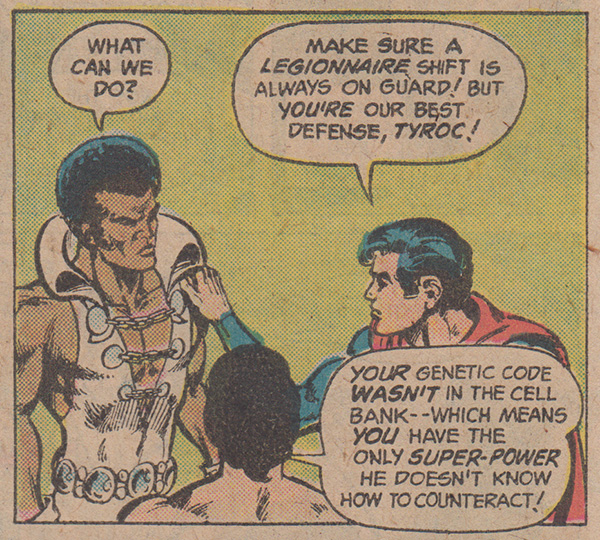
Tyroc’s previous exclusion from the Legion is painted as a positive thing, as his genes were not among those collected.
But that is not really all that remains, both the reader and Tyroc are kept in the dark about a final test, involving a villain named Zoraz. The story the Legion gives Tyroc is that Zoraz managed to steal the genetic samples of all the Legion members that the team had locked away out of the hope of one day “cloning Legionnaire replacements,” and thus the villain was able to use his “undisputed scientific knowledge to analyze [their] cells…providing him with the vital data he needs to turn [their] own power against” them. Tyroc is told that since he was not yet a member when this theft happened, he is the group’s best defense, as his genetic code was not among those Zoraz could use against them. Tyroc’s exclusion from the Legion’s genetic project is not only framed as making that exclusion a benefit for the Legion but is painted as giving him the opportunity to prove his heroism by coming to the Legion’s aid. This story’s attempt to use Tyroc’s previous lack of inclusion as a benefit to the Legion and making that benefit a genetic one, doubles-down on justifying his exclusion and moves to exculpate the Legion for any complicity in the 30th century’s apparent segregation. The scenario’s logic essentially contends that if Tyroc had been included earlier, they would have no defense against Zoraz.
Significance of the Study?
Tyroc first discovered his abilities while saving his playmates from an approaching demon from neighboring dimensional space. Tyroc’s home of Marzal was like the fabled Brigadoon, a piece of land which vanished from Earth to another dimension for extended periods of time. Marzal would spend several years on Earth as an island off the coast of Africa before vanishing for several more years, only to reappear again. As he became an adult, Tyroc served as his people’s champion being the only one with powers to help ward off visitors and other trespassers. Troy took the name Tyroc as it fit his sonic scream abilities, being a Marzalian translation of “Scream of the Devil.”
In the retconned Five Years Later continuity, Marzal was eventually destroyed with Tyroc surviving on Earth. He went on to join Jacques Foccart’s cell of Earth resistance to the Dominion. When Jacques was elected President of Earth after the Dominion was defeated, Troy became his Vice President. Jacques would shortly thereafter resign following Earth’s destruction, leaving President Stewart in charge of New Earth. He vanished during the Zero Hour event which ended that continuity during a crucial effort to ward off the time fluctuations.
Years later, following Earth Man’s Justice League and the reformation of the Legion of Super-Heroes, Tyroc and presumably Marzal have returned off-panel to Earth’s dimension. Tyroc has rejoined the Legion and has displayed a more refined as well as boisterous control over his sonic scream.
He often spent lengthy stints of time back home on Marzal Island to protect it, causing several Legionnaires to feel he was neglecting his duties as an active member. Soon there after, Tyroc resigned from the team and ended his short tenure as a Legionnaire. He gave no explanation before vanishing to his home, causing the confusion of many Legionnaires. Dawnstar and Shadow Lass went to Marzal to investigate, only to find Tyroc furious with them. They had stumbled upon Marzal’s soil just as the island left Earth and its dimension for an undisclosed amount of years. Using his sonic powers and working together one last time, the Legionnaires were eventually able to blaze a trail home with Dawnstar leading the way. The Legion ladies encouraged Tyroc to come back with them to Earth, but he refused and faded with Marzal.
Voice-induced Manipulation
Sonic Scream
Tyroc possesses a sonic scream; the pitch, volume, and words of his scream could initially vary to produce a variety of different effects. Abilities Tyroc manifested with his scream included teleportation, pyrokinesis, and wind manipulation. His range and extent of his abilities were ill-defined and very expansive. More recent depictions have shown Tyroc with a more straightforward, concussive sonic scream with additional echolocation abilities.